Category: Dataverse

  • Creating Navigation Buttons for Different Views in Model-Driven Apps

    Creating Navigation Buttons for Different Views in Model-Driven Apps

    When building model-driven apps, one common frustration is the limitation of adding a single table with only a default view. For example, if you have a Contacts table with a Choice field, and you’ve created a view for each choice, users have to select Contacts first, then navigate to the desired view manually.

    But what if you could streamline this process by adding separate navigation buttons for each view directly in the app’s left-hand navigation bar? This blog post will walk you through how to achieve that using URL-based navigation—no extra coding required.

    1. The Scenario
    2. Setup
      1. Step 1: Create views
      2. Step 2: Get the entitylist ID and view ID
      3. Step 3: Edit model-driven app to add URL

    The Scenario

    This is a small example, but the functionality I am about to show you is very powerful, and can help streamline UX.

    Imagine you have:

    • A Contacts table in Dataverse.
    • A Choice field in the Contacts table called Contact Type with options like Client, Vendor, and Partner.
    • Custom views for each Contact Type, such as Client Contacts, Vendor Contacts, and Partner Contacts.

    By default, when adding the Contacts table to your app, only one button appears on the navigation bar, leading to the default view. Users must manually switch to the other views. This approach isn’t user-friendly for frequent switching between views. Especially when some users only care about certain contact types.

    Setup

    Step 1: Create views

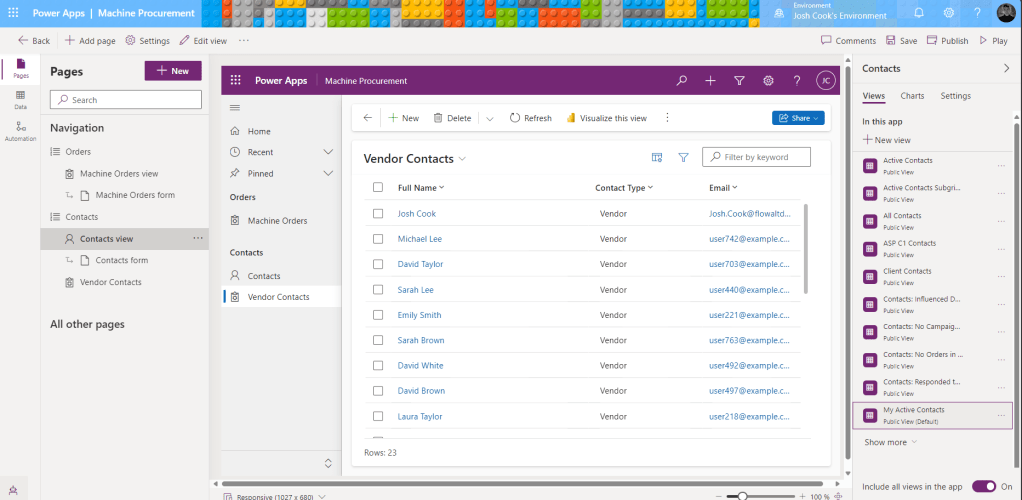
    First you will want to create a view for each button on the navigation. In my case I created a view for Vendor Contacts, and Client Contacts. Each view I added a simple filter to show only that Contact Type

    Example:


    Step 2: Get the entitylist ID and view ID

    Play your model driven app, select the Table and choose the view.
    Now look at the URL, and copy everything after entitylist&etn=

    So in my example the Vendor Contacts view URL is:
    contact&viewid=ee7b9134-7cb2-ef11-a72f-000d3af40ac9&viewType=1039

    Next add this to the beginning of the URL you just copied:
    /main.aspx?pagetype=entitylist&etn=

    So my final URL will be:
    /main.aspx?pagetype=entitylist&etn=contact&viewid=ee7b9134-7cb2-ef11-a72f-000d3af40ac9&viewType=1039

    This will be the URL we use as our navigation link.


    Step 3: Edit model-driven app to add URL

    Edit your model driven app, click +New, and select Navigation link

    Add the URL we built in Step 2, and give it a name, click Add
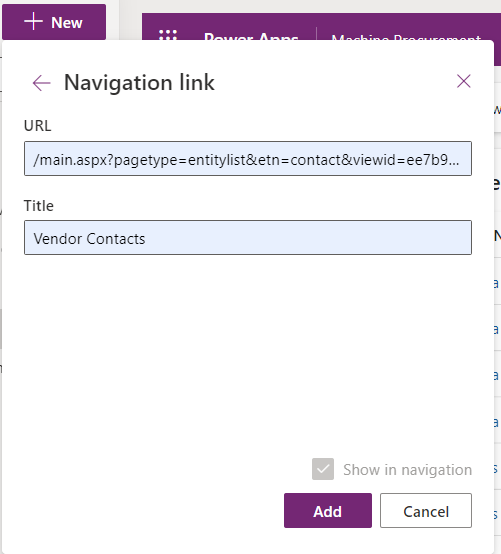
    NOTE: If you get an error, it means your URL is wrong. Follow Step 2.

    By leveraging this simple yet effective approach, you can elevate the user experience in your model-driven apps, making navigation more intuitive and streamlined for your team.

    Special thanks to Kevin Nguyen for showing me how to do this.

    Let me know how this works for your app or if you have other creative solutions to share!

  • Dataverse Record Level Security

    Dataverse Record Level Security

    The scenario here is to enable row level security within the concepts of Dataverse inside a Model-Driven App. Important to note, this can be applied to Canvas or Model-driven apps.

    For example:
    I have a Sale Commission table which is connected to a Model-Driven App. One of the columns is a choice called Store.

    The concept is; we only want users to see records from their own respective stores. This concept seems straight forward and easy.. After some digging and reading documentation and asking some friends in understanding this model. I found a way to do this. So here it is!

    Video Tutorial

    Prerequisites

    The feature that will help us in this concept is called Matrix data access structure (Modernized Business Units). Click the link to read more into it. But I will articulate what we need to do.

    Enable record ownership across business units (preview)

    First we need to enable this feature on an environment. Follow the steps below to enable this feature.

    1. Sign in to the Power Platform admin center, as an admin (Dynamics 365 admin, Global admin, or Microsoft Power Platform admin).
    2. Select the Environments tab, and then choose the environment that you want to enable this feature for.
    3. Select Settings > Product > Features.
    4. Turn On the Record ownership across business units toggle.
    5. Click Save.
    Record ownership across business units (Preview)

    Setup steps

    This guide is assuming you have your Dataverse tables built.
    We need to setup a few things to get this functionality to work:

    1. Create Business Units
    2. Create security role
    3. Assign security role
    4. Create Business rule

    Create Business Units

    We are creating a Business unit for each “Store” in this example.
    Creating business units in the Power Platform Admin center:

    1. In the Admin center, select your environment.
    2. Select the Settings cog in the top.
    3. Under Users + permissions.
    4. Select Business units.
    Showing step 4. Clicking Business units
    1. Click New, and create as many business units as you need.
    2. In this example, I am creating 3. One for each store.
    Showing all business units that have been created

    Create security role

    We want to create a security role. This is a role to give access to the custom tables we have for Dataverse, as well as privileges for Business unit. This will allow users to append different Business units to new records.

    While still in the Admin center;

    1. Click See all under Security roles.
    Admin center showing the security role option
    1. Click, New role or edit an existing role.
    2. When editing the role click the Custom Entities tab.
    3. Find your table that users will be interacting with. In this example, its Sale Commission table.
    4. Set this table to:
      Read = Business unit
      Create = Parent child business unit
    Showing the Sale commission permission
    1. Next, click the Business Management tab.
    2. Set the Business Unit table to:
      Read = Parent child business unit
      Write = Parent child business unit
      Append To = Parent child business unit
    Showing the Business Unit permissions
    1. Click Save and Close.

    Assign security role

    Now we need to assign the security role to users based on the Business unit. To do that follow the steps:

    While in the Admin center;

    1. Click See all under Users.
    2. Select a user to assign the Business unit role to.
    3. Click Manage roles.

    Notice that we can change the Business unit the Security role can be assigned under.

    Showing the new option to select Security roles under each Business unit

    In this example, I am assigning the role under each Business unit to give permissions.

    1. Select the Business unit and assign the role.
    UserRoles assigned + Business unit
    AdeleSales Contributor in MainStore-BU
    AlexSales Contributor in NorthStore-BU
    Sales Contributor in DowntownStore-BU
    Showing a table of permissions

    Based on the table above.

    • Adele can see all records part of the Main store
    • Alex can see all records in North Store and Downtown Stores
    1. Click Save.

    Create Business rule

    Now that the feature has been enabled and configured, we still need to change the Owning Business Unit field based on the selected store. There are many ways to do this, but for this example, I will be using a Business rule.

    To configure a Business rule;

    1. Navigate to your solution, or where the table (Sale Commission) is in Power Apps.
    2. Select the table, and click Forms.
    3. Select the form that users will be using when creating records.
    4. Once the form is opened, add the Owning Business Unit field, and select it
    5. Once selected, click Business rules on the right pane.
    6. Click New business rule.
    7. Give the rule a meaningful name.
    8. In the default condition, in the properties tab mine looks like this:
    Business rule condition 1

    For the rule, I am going to add a Condition to the “is false” and continue to do this for each Business unit / Store I want to check.
    Here is what mine looks like after adding all the conditions:

    All conditions added to Rule

    Next we need to Set the values of the business unit based on the store.

    1. In the components tab, add a Set Field Value action to all the “Is true” paths.
    2. With the Set Field Value selected, click on the Properties tab.
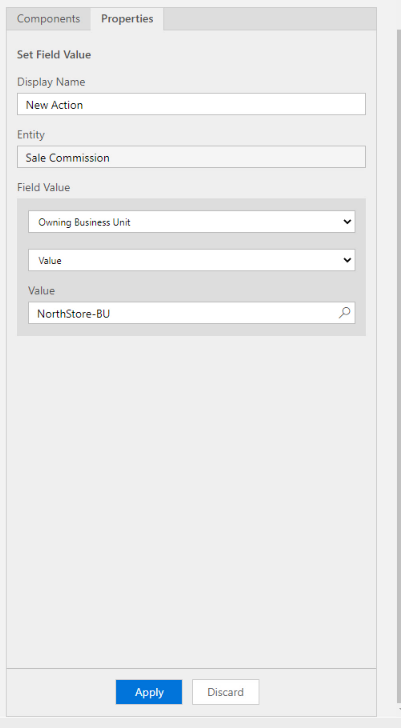
    3. Select Owning Business Unit for Field and the right Value. Example for the NorthStore:
    Set Field Value properties for North Store
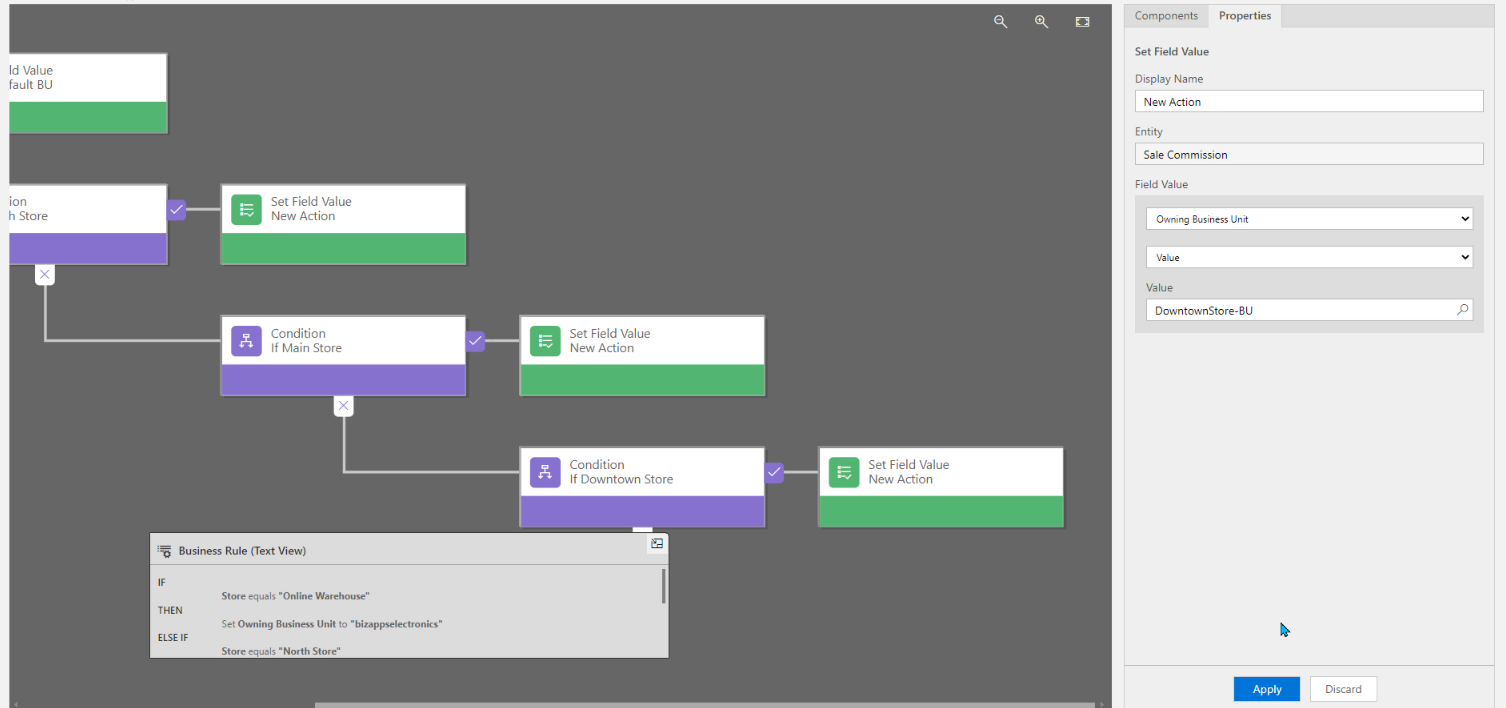
    1. Do this for all the Conditions. Mine looks like this:
    Completed Business Rule
    1. After you’re done, click Validate.
    2. If validation is good, click Save.
    3. After saved, click Activate.

    That’s it. Done!!
    Now when a user selects the Store, it will automatically change the Owning Business Unit.

    Form view of Owning Business Unit changing based on Store selected.
  • Power Apps Choosing Which Connections To Use Using Power Automate

    Power Apps Choosing Which Connections To Use Using Power Automate

    You may have run into an issue when creating Power Apps that needs to submit data to SharePoint, Dataverse, etc. But did not want to give everyone in the app access to these.
    The problem is, Power Apps uses the connections of the user using the app, meaning if the app writes to a SharePoint List, the user will need Read/Write access.
    The same goes for Power Automate if we try to send the data to Power Automate from Power Apps, it still uses the users connection who triggered the Flow.
    How can we get around this? Read below!

    Table of Contents


    Known Issues

    1. If you block the HTTP Request connector via data loss prevention (DLP), child flows are also blocked because child flows are implemented using the HTTP connector. Work is underway to separate DLP enforcement for child flows so that they are treated like other cloud flows.
    2. You must create the parent flow and all child flows directly in the same solution. If you import a flow into a solution, you will get unexpected results.
      Call Child Flows – Power Automate | Microsoft Docs

    Prerequisites

    1. The Flows must be created inside the same Solution, so a Dataverse database must be configured on the Power Platform Environment

    The Scenario

    In this scenario, I will be showing how a user can use Power Apps to create items in a SharePoint List without being a member of the Site. This will allow us to use a specific Service Account to create the data in SharePoint without giving the user in the app any permission at all!

    First we will build the Child Flow, then Parent Flow, and lastly customize the Power App

    Child Flow

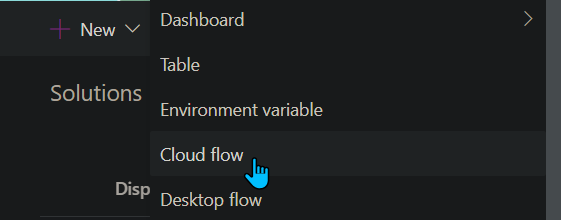
    Inside your Solution create a new Cloud Flow.

    1. For our trigger we use a Manual Button, and add the data we are expecting from Power Apps to put inside our SharePoint List
      (In my example I am only bringing in one field for Title)
    2. Next, I add a Create Item action for my SharePoint List, and add the Parameters from the trigger inside the action.
    3. Lastly, I add a ‘Respond to PowerApp or flow’ action, I create an Output called Success, and some details about what was created.
    Child Flow


    Make sure to use the Connection you want users of the App to use for the SharePoint Create item action.

    Save and go back to the Flow dashboard screen (where you see the Details and run history screen).

    There will be a Card on the right side called ‘Run only users’ click Edit

    Run only users

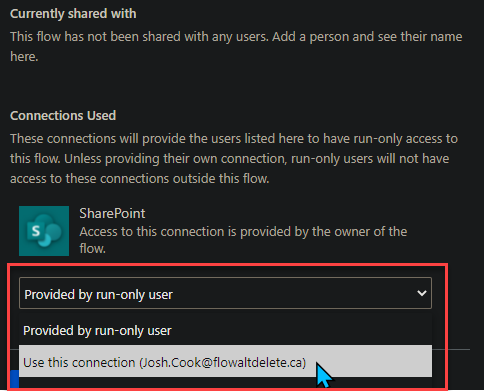
    Under Connections Used, switch ‘Provided by run-only user’ to the connection you want to be used by users of the App
    (They wont have access to this Connection outside this Flow)

    Run only user

    Click Save,

    Now onto the Parent Flow

    Parent Flow

    Go back to the Solution and Create another Cloud Flow.

    1. For our trigger we use the PowerApps button trigger.
    2. As best practice, create Variables for your data that is coming from Power Apps. Don’t forget to name them, as this will be the parameter name in Power Apps,
      Use the ‘Ask in PowerApps‘ dynamic content for your variable values.
    3. Next we use a action called ‘Run a Child Flow’
      (If you do not see this action, your Flow was not created inside a Solution)
      Add the parameters (these were the input parameters from the last Flow that we just created).
    4. Lastly, add ‘Respond to a PowerApp or flow’ action. For this demo I am adding the parameter ‘Success’ this is from the child Flow.


    Click Save.

    Power App

    Now onto the Power App, I am going to create a simple Power App with 1 TextInput for Title, and a Button to Pass the data to Power Automate.
    Here are my controls for reference:

    TextInput_Title
    Button_SendToFlow

    For the Button:
    1. Add the Flow to the button by clicking on the Button,
    2. Clicking Action tab on top of page,
    3. Clicking Power Automate
    4. Select the Flow


    Next add the parameters for the Flow, in my case I am adding the TextInput_Title.Text

    Now, I want to add a Notification that the Item has been added, which will confirm my Flow has Run correctly. Ill be using the ‘Success’ Output parameter from the Flow for this.

    To add this, I put my Flow run inside a Variable inside Power Apps. Ill call my variable Results, and IO add this to the OnSelect property of the Button where my Flow is:

    Now I use the ‘Notify’ function to notify the user of the item being created, I add this after the semicolon. So my function looks like this in the end:


    So my final code looks like this:

    Set(
        Results,
        'PA-Trigger1'.Run(TextInput_Title.Text)
    );
    Notify(
        Results.success,
        NotificationType.Success
    );
    Reset(TextInput_Title)
    

    Now lets test it!

    Conclusion

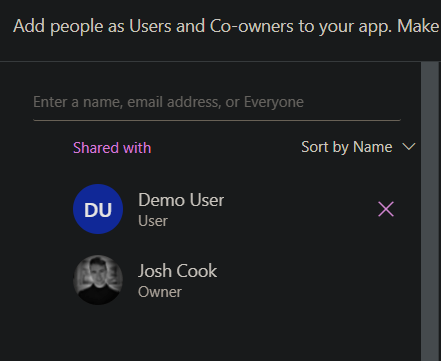
    I am using a User called ‘Demo User’ I have shared the App with this user. But they are not part of the SharePoint Site


    Here is the SharePoint Site:

    Now Logged in as the Demo User to test this:

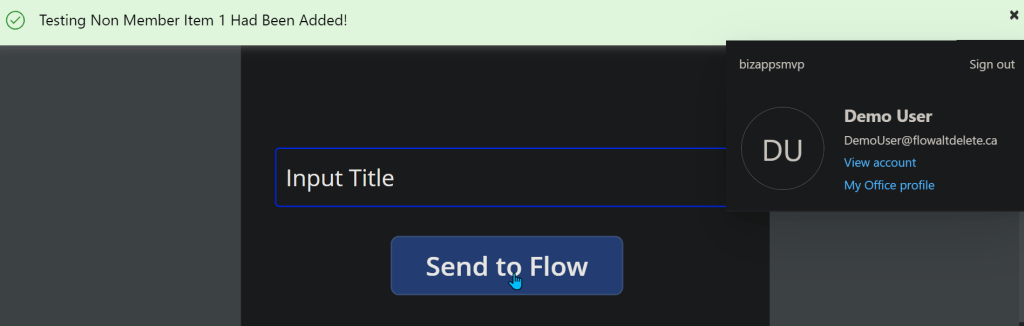
    Logged in as Demo User


    Button Clicked >

    Button Pressed, Flow Completed

    Now to check SharePoint >

    Test Success!!

    Done!
    So this was just a basic example on how we can create data inside a Data Source that the user of the App does not need access too.

  • Adding Security Roles and Field Security Profiles to Users in CDS using Power Automate

    Adding Security Roles and Field Security Profiles to Users in CDS using Power Automate

    The Scenario

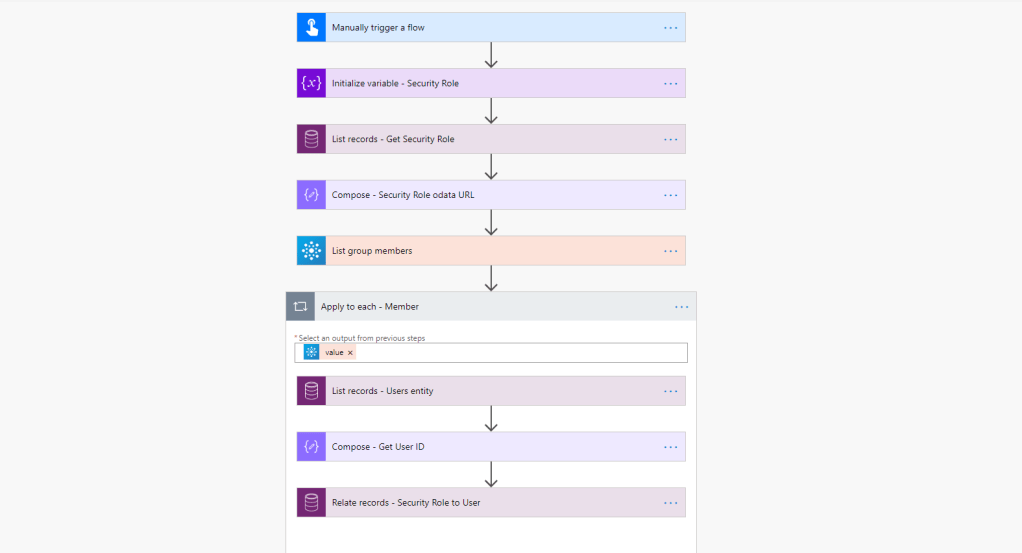
    We will be adding a Security Role / Field Security Profile to users in CDS. For this demo, our scenario will be grabbing all the users from a Office365 group and assigning them a certain Security Role / Field Security Profile.

    The source of the users can be from anywhere:
    – MS Form
    – SharePoint
    – Array inside the Flow
    – Excel Table
    – AAD Group / Office365 Group

    Prerequisites

    We will be using the Common Data Service Current Environment connector. This means that our Flow, MUST be created inside a Solution.

    You will need appropriate permissions to be able to assign Security Roles and Profiles to

    Steps

    INFORMATION:
    This Flow will work the exact same to add Field Security Profiles instead of Security Roles. The only changes you have to make are in the List records – Get Security Role, and the Relate records – Security Role to User. The changes are listed in the captions of those images.

    We use a Variable to store the name of the Security Role we want to add to the users.
    Than use a List records action on the Entity Security Roles
    In our Filter Query we will use:
    name eq ‘ ‘
    Since we are using a variable to store the name of the Security Role, we pass this into the Filter Query

    Field Security Profile = Change Entity name to Field Security Profile

    Next, add a Compose action, to get the Odata URL. This URL is how we will add the Security Role to the User later on.

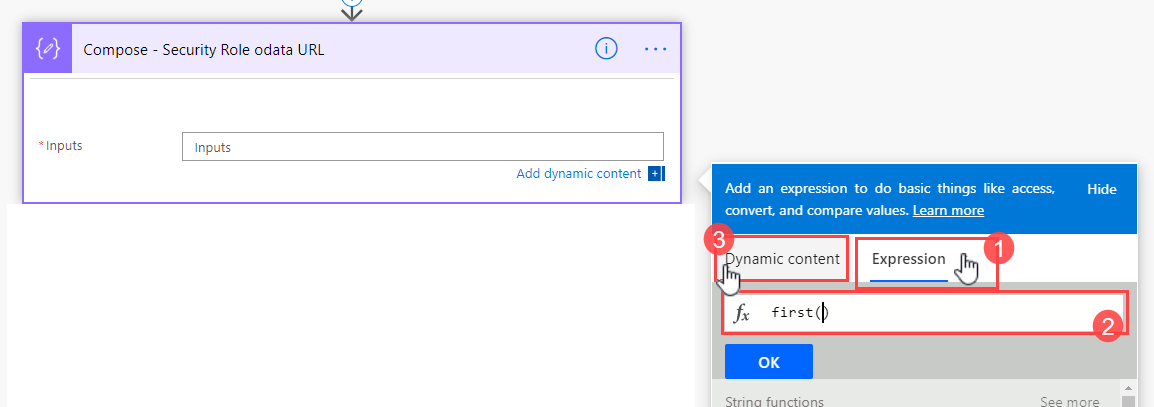
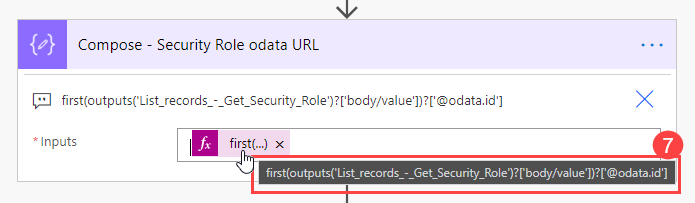
    first(outputs('List_records_-_Get_Security_Role')?['body/value'])?['@odata.id']
    

    To build the above expression follow these steps:

    1) Inside the Compose action select Expression tab
    2) Use the expression first()
    3) Click back to Dynamic content tab

    We use first() to get the first value in the CDS List records action. This allows us to bypass the Apply to each loop that Flow creates for us

    4) In the ( ) select the Dynamic content value from the List records action

    TIP: Make sure you see the fx logo in the text box, this indicates we are using an expression

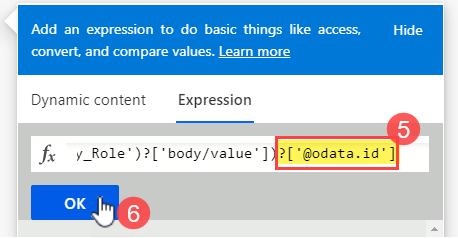
    5) At the end of the expression add:

    ?['@odata.id']
    

    6) Click OK

    7) Confirm the expression saved correctly by hovering your mouse over the expression

    Next, use any data source / connector that meets your needs to get the emails of your users that you want to add – In this example I am using Office365 List group members

    Add an Apply to each loop – So we can loop through each email and assign the Security Role

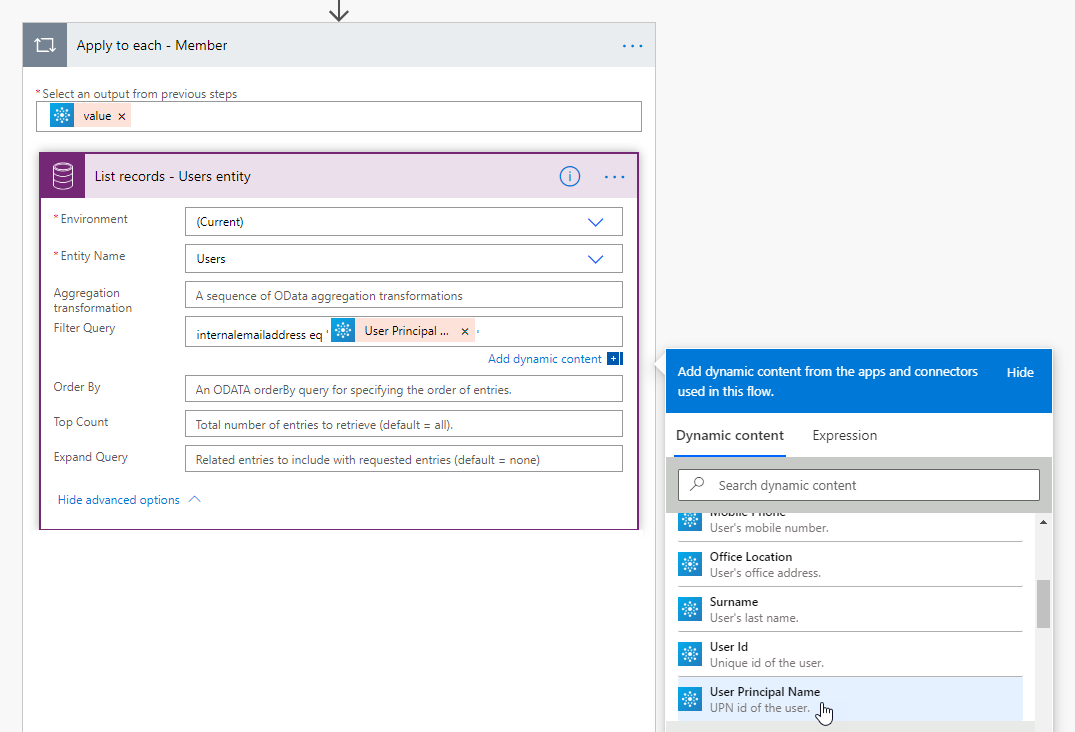
    Inside the Apply to each loop, add a List records action on the Users entity
    Filter Query = internalemailaddress eq ‘ ‘
    Add your dynamic content that has the email address for the user to add inside the ‘ ‘

    Next, add a Compose action – to store the User ID (Unique ID)
    We use the same technique as mentioned above, using first() and the field name
    Add this to the end of your expression

    ?['systemuserid']
    
    systemuserid = the field name in CDS that stores the Unique value for each user. This value is used as a lookup guid. So we can relate the records to this guid

    Still inside the Loop:
    Add a Relate Records action.. This is one of the actions inside the Common Data Service Current Environment Connector.
    Entity Name: Users
    Item ID: The Compose – Get User ID Outputs
    Relationship: Select ‘Security Role – systemuserroles_association’ from the drop-down
    URL: The Compose – Security Role odata URL

    Field Security Profile = Change Relationship Dropdown to — Field Security Profile – systemuserprofiles_association

    Your action should look like this:

    Conclusion

    Adding Security roles or Field Security Profiles, can be a long and tedious process. You can add this Flow to a MS form and have users fill out what roles they need.

    Thanks for reading!