Blog

  • Tip For Testing Your Flows In Power Automate

    Tip For Testing Your Flows In Power Automate

    If your like me, you test your Flows over and over again. This results in sending unwanted emails, creating items in SharePoint or Dataverse, Creating files on OneDrive or SharePoint.
    Every time you test your Flow, these actions inside our Flow get executed and cause unwanted behavior when Testing.

    Wouldn’t it be nice if we can Test our Flows without executing these actions? Guess what we can! And its very easy to do. Check this out!

    Scenario

    For example, I have a Flow that Create a new row in Dataverse, and then send an email to the person who created the new row. That is fine, but what happens when we have other actions in our Flow that we want to test to make sure they are correct.
    I may want to test the Flow multiple times if I am doing some data manipulation, but this will result in Creating multiple unwanted rows (records) in Dataverse, as well as send emails every time.

    We can clean up the testing process easily.

    How?

    We can utilize a feature called Static Result.

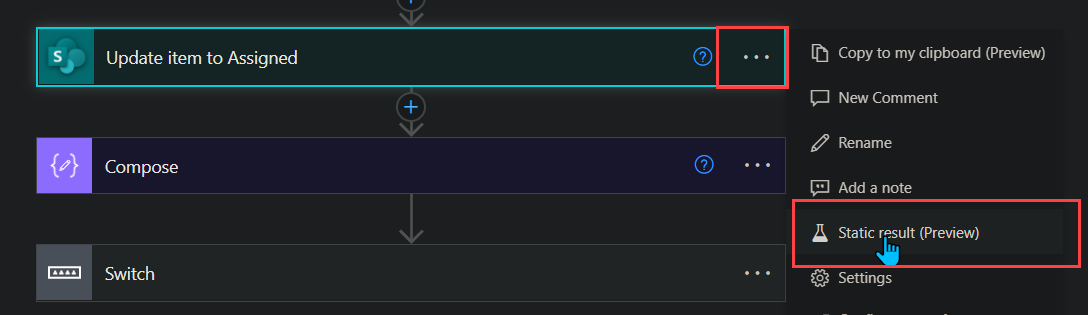
    First click the 3 dots on the action, and select Static Results.
    Next we can configure the static results. For easy example click the radio button to enable, select your Status, and the Status Code.
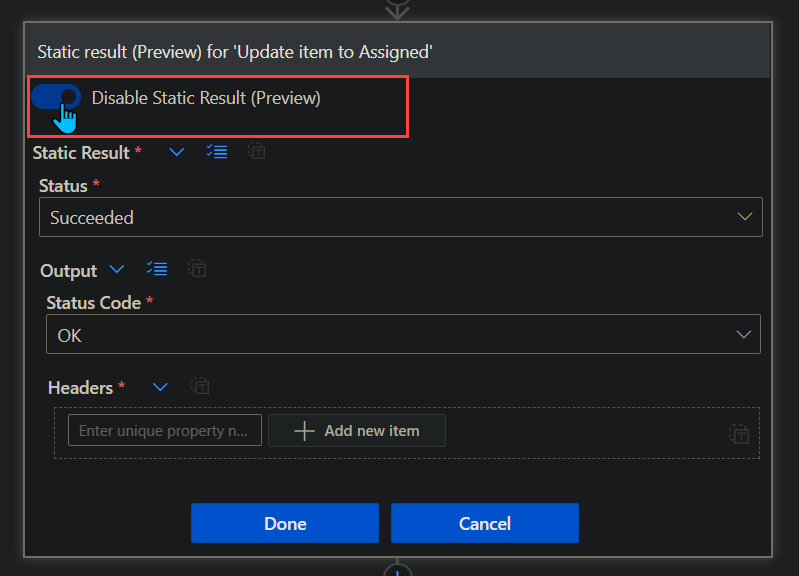
    Click Done.

    Now the action will have a yellow beaker, indicating that the action is using Static results.

    Things to note:
    – Static Result are in ‘Preview’ so it could change at any time
    – Not all actions will be able to use them
    – If the option is greyed out, and you’re certain the action is able to use it, save the Flow and re open

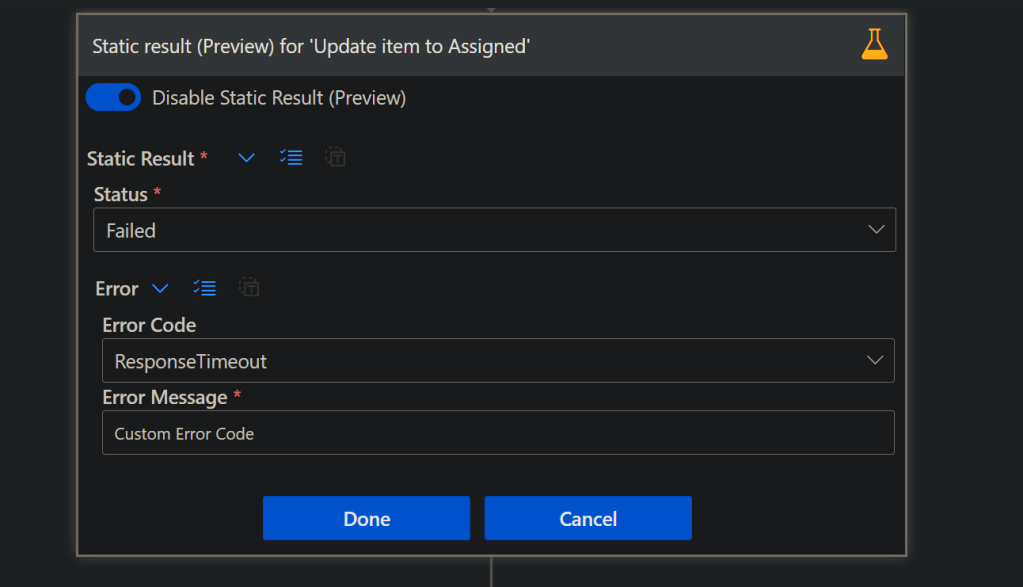
    This is only the beginning, as you can create a custom failed response, or create any result you want. This can help troubleshooting and testing certain scenarios.

    REMEMBER!! To turn off static results when you want to execute the actions like normal.

    Examples

    Some examples on when to use static results:

    • Flow runs without sending emails
    • Flow runs without Approvals needed
    • Flow runs that need to test errors on certain actions
    • Flow runs testing different error codes (Advanced) + Custom error codes

    Conclusion

    I have used this feature for awhile now, and noticed not many know about it. It’s so useful in many testing scenarios. Just remember to disable the static results once your done testing!

    If you have any questions or want to add anything please leave a comment and like this post! Thank you!
  • How to Use Regular Expressions in Microsoft Power Virtual Agents With Examples

    How to Use Regular Expressions in Microsoft Power Virtual Agents With Examples

    Regular Expressions in Power Virtual Agents? Sounds like a pretty advanced topic. But it’s actually not that difficult and can save you hours of time if you’re trying to validate user input for things such as credit card numbers, tracking IDs, custom invoice numbers or even IP addresses. In this post we’ll cover some of the basics of Regular Expression syntax so you can get started using them inside Power Virtual Agents.

    Summary

    To utilize regular expressions inside Power Virtual Agents, we must first create a new entity.
    This can be be done by clicking the Entities tab > New entity.

    Now select Regular expression (Regex)

    PVA does a great job in providing some general use case examples.

    The syntax is based on .NET


    RegEx Examples in PVA

    Below you will find some examples you can copy and paste directly into the Pattern for your Regular Expression:

    PatternDescription
    ^(?:(?:25[0-5]|2[0-4][0-9]|[01]?[0-9][0-9]?).){3}(?:25[0-5]|2[0-4][0-9]|[01]?[0-9][0-9]?)$IP Address
    – Looks for X.X.X.X format
    – Each X range in 0-255
    – X length 0-3
    ^4[0-9]{12}(?:[0-9]{3})?$Visa Credit Card numbers
    – Start with a 4
    – Old cards use 13 digits
    – New cards use 16 digits
    ^3[47][0-9]{13}$American Express
    – Starts with 34 OR 37
    – All have 15 digits
     ^(?:5[1-5][0-9]{2}|222[1-9]|22[3-9][0-9]|2[3-6][0-9]{2}|27[01][0-9]|2720)[0-9]{12}$Mastercard
    Starts with either:
    51-55 OR 2221-2720
    – All have 16 digits
    ^(?!0{3})(?!6{3})[0-8]\d{2}-(?!0{2})\d{2}-(?!0{4})\d{4}$Social Security Number
    – SSN are 9 digits
    – Looks for XXX-XX-XXXX format
    – Cannot contain all zeros
    – Cannot begin with 666 OR 900-999
    ^[a-fA-F0-9]{2}(:[a-fA-F0-9]{2}){5}$Mac Address
    – 6 byte hex separated by colon “:” OR dash “-”
    ^((6553[0-5])|(655[0-2][0-9])|(65[0-4][0-9]{2})|(6[0-4][0-9]{3})|([1-5][0-9]{4})|([0-5]{0,5})|([0-9]{1,4}))$Port Number
    – Matches valid port number in computer network
    – 16 bit
    – Ranges from 0-65535
    [A-Z]{2,}-\d+Jira Ticket Number
    – Looks for format Hyphen-separated Jira project key and ticket issue number
    ^(bc1|[13])[a-zA-HJ-NP-Z0-9]{25,39}$Bitcoin Address
    26-35 alphanumeric characters
    – Start with 1 OR 3 OR bc1
    ^[0-9a-fA-F]{8}\b-[0-9a-fA-F]{4}\b-[0-9a-fA-F]{4}\b-[0-9a-fA-F]{4}\b-[0-9a-fA-F]{12}$UUID / {guid}
    – 36 characters
    – 128 bit, represented in 16 octets
    – Looks for format form of  8-4-4-4-12

    Using them in PVA

    Once we create the Entity, and define the pattern for our RegEx. We can now use this validation inside our PVA chat.

    For example, I will test the IP Address pattern

    ^(?:(?:25[0-5]|2[0-4][0-9]|[01]?[0-9][0-9]?).){3}(?:25[0-5]|2[0-4][0-9]|[01]?[0-9][0-9]?)$
    

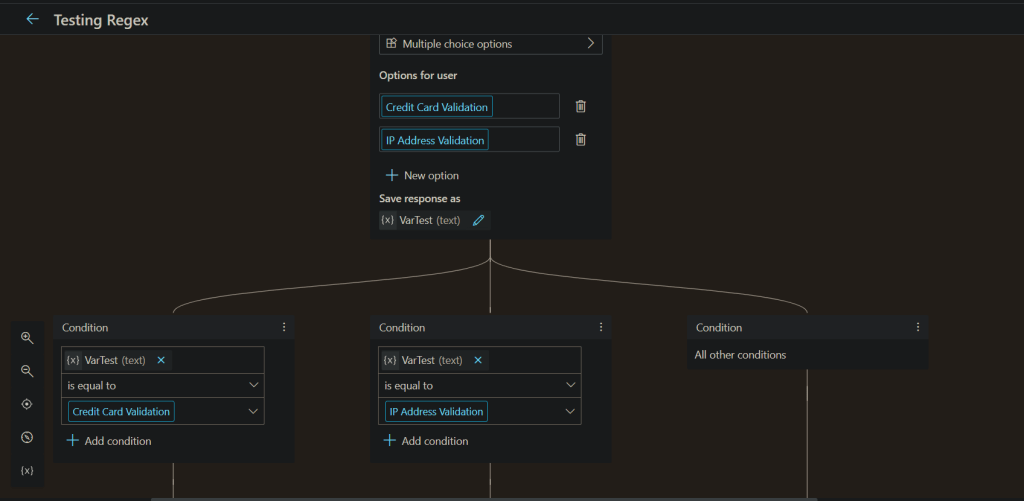
    I have created a topic for testing my RegEx.

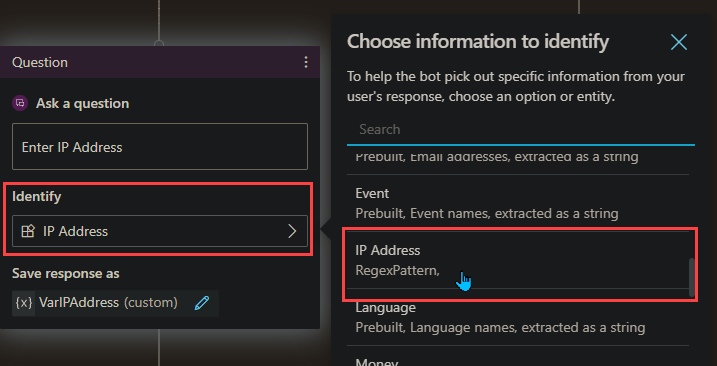
    To use the newly created entity, Add a Question, under Identify select your Custom Entity

    Under this, I add a message to confirm its valid.
    (Note, the bot will automatically let the user know if the validation does not match)

    Testing the RegEx

    Okay, drumroll….
    The values I will be testing are

    User InputValid?
    192.168.1.1Valid ✔
    127.0.0.1Valid ✔
    999.55.1.5Not Valid ✖
    Not A IP AddressNot Valid ✖

    Conclusion

    Being able to use Regular Expressions inside Power Virtual Agents can be extremely powerful. And with the above list of common patterns, I hope you find value in this post.

    Thank you, and have a great day!

  • Power Apps Choosing Which Connections To Use Using Power Automate

    Power Apps Choosing Which Connections To Use Using Power Automate

    You may have run into an issue when creating Power Apps that needs to submit data to SharePoint, Dataverse, etc. But did not want to give everyone in the app access to these.
    The problem is, Power Apps uses the connections of the user using the app, meaning if the app writes to a SharePoint List, the user will need Read/Write access.
    The same goes for Power Automate if we try to send the data to Power Automate from Power Apps, it still uses the users connection who triggered the Flow.
    How can we get around this? Read below!

    Table of Contents


    Known Issues

    1. If you block the HTTP Request connector via data loss prevention (DLP), child flows are also blocked because child flows are implemented using the HTTP connector. Work is underway to separate DLP enforcement for child flows so that they are treated like other cloud flows.
    2. You must create the parent flow and all child flows directly in the same solution. If you import a flow into a solution, you will get unexpected results.
      Call Child Flows – Power Automate | Microsoft Docs

    Prerequisites

    1. The Flows must be created inside the same Solution, so a Dataverse database must be configured on the Power Platform Environment

    The Scenario

    In this scenario, I will be showing how a user can use Power Apps to create items in a SharePoint List without being a member of the Site. This will allow us to use a specific Service Account to create the data in SharePoint without giving the user in the app any permission at all!

    First we will build the Child Flow, then Parent Flow, and lastly customize the Power App

    Child Flow

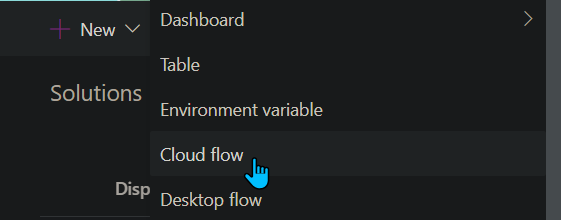
    Inside your Solution create a new Cloud Flow.

    1. For our trigger we use a Manual Button, and add the data we are expecting from Power Apps to put inside our SharePoint List
      (In my example I am only bringing in one field for Title)
    2. Next, I add a Create Item action for my SharePoint List, and add the Parameters from the trigger inside the action.
    3. Lastly, I add a ‘Respond to PowerApp or flow’ action, I create an Output called Success, and some details about what was created.
    Child Flow


    Make sure to use the Connection you want users of the App to use for the SharePoint Create item action.

    Save and go back to the Flow dashboard screen (where you see the Details and run history screen).

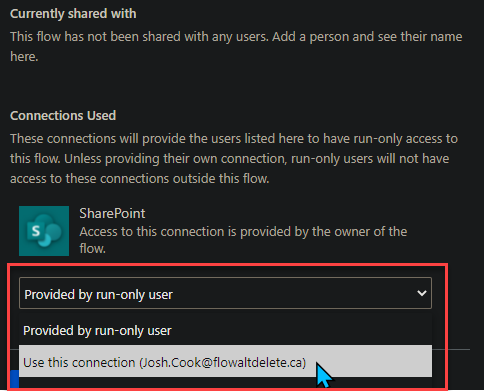
    There will be a Card on the right side called ‘Run only users’ click Edit

    Run only users

    Under Connections Used, switch ‘Provided by run-only user’ to the connection you want to be used by users of the App
    (They wont have access to this Connection outside this Flow)

    Run only user

    Click Save,

    Now onto the Parent Flow

    Parent Flow

    Go back to the Solution and Create another Cloud Flow.

    1. For our trigger we use the PowerApps button trigger.
    2. As best practice, create Variables for your data that is coming from Power Apps. Don’t forget to name them, as this will be the parameter name in Power Apps,
      Use the ‘Ask in PowerApps‘ dynamic content for your variable values.
    3. Next we use a action called ‘Run a Child Flow’
      (If you do not see this action, your Flow was not created inside a Solution)
      Add the parameters (these were the input parameters from the last Flow that we just created).
    4. Lastly, add ‘Respond to a PowerApp or flow’ action. For this demo I am adding the parameter ‘Success’ this is from the child Flow.


    Click Save.

    Power App

    Now onto the Power App, I am going to create a simple Power App with 1 TextInput for Title, and a Button to Pass the data to Power Automate.
    Here are my controls for reference:

    TextInput_Title
    Button_SendToFlow

    For the Button:
    1. Add the Flow to the button by clicking on the Button,
    2. Clicking Action tab on top of page,
    3. Clicking Power Automate
    4. Select the Flow


    Next add the parameters for the Flow, in my case I am adding the TextInput_Title.Text

    Now, I want to add a Notification that the Item has been added, which will confirm my Flow has Run correctly. Ill be using the ‘Success’ Output parameter from the Flow for this.

    To add this, I put my Flow run inside a Variable inside Power Apps. Ill call my variable Results, and IO add this to the OnSelect property of the Button where my Flow is:

    Now I use the ‘Notify’ function to notify the user of the item being created, I add this after the semicolon. So my function looks like this in the end:


    So my final code looks like this:

    Set(
        Results,
        'PA-Trigger1'.Run(TextInput_Title.Text)
    );
    Notify(
        Results.success,
        NotificationType.Success
    );
    Reset(TextInput_Title)
    

    Now lets test it!

    Conclusion

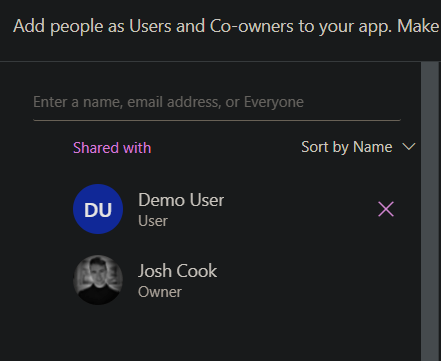
    I am using a User called ‘Demo User’ I have shared the App with this user. But they are not part of the SharePoint Site


    Here is the SharePoint Site:

    Now Logged in as the Demo User to test this:

    Logged in as Demo User


    Button Clicked >

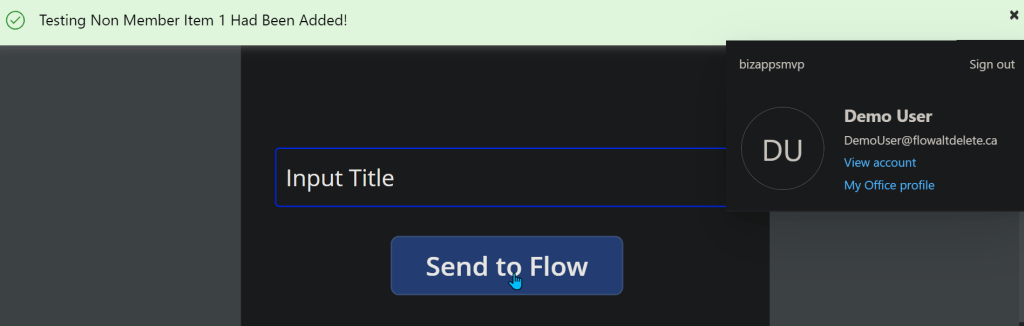
    Button Pressed, Flow Completed

    Now to check SharePoint >

    Test Success!!

    Done!
    So this was just a basic example on how we can create data inside a Data Source that the user of the App does not need access too.

  • Check Conditions In Power Automate During Run

    Check Conditions In Power Automate During Run

    The Problem?

    Is your Condition not working as expected?
    The problem is when we use a Condition action inside Power Automate, we cannot see the “equation” that is being evaluated when looking into the run.

    The problem affects how we can troubleshoot, the following solution will show what is happening inside the Condition action during the run.

    Scenario

    In this scenario, I am checking:
    If one value is greater than a second value

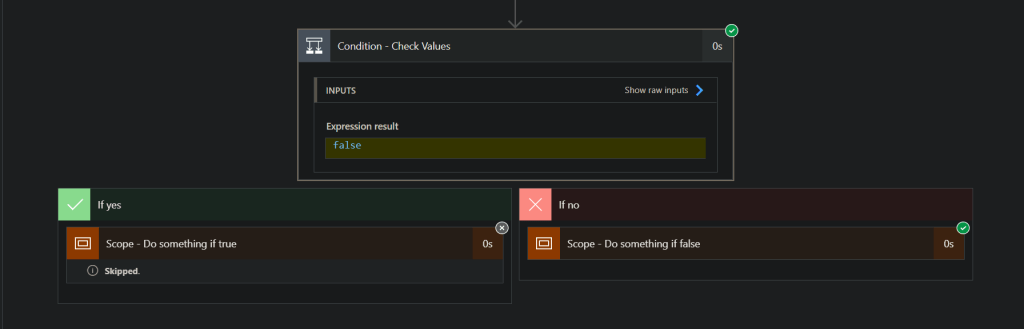
    Now during a test run, I expect to see this condition true, but in my run it is always showing false and going in the If no branch.

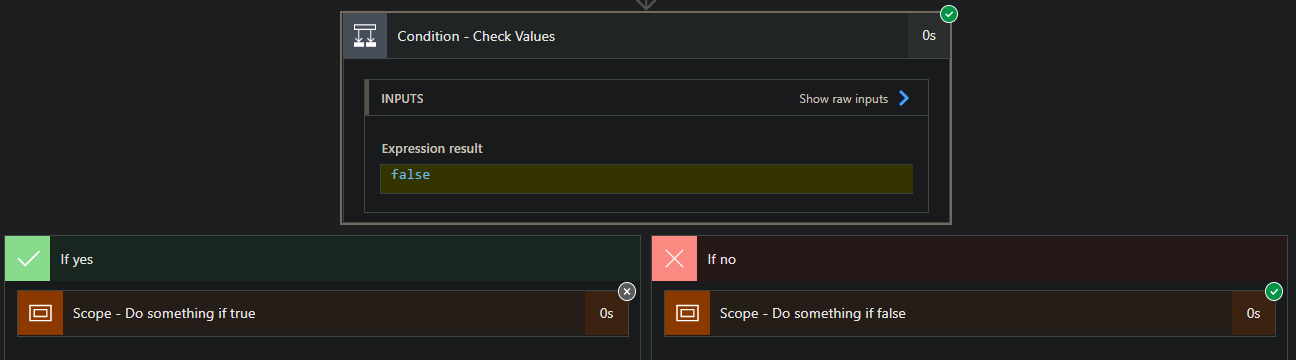
    The big problem is though, I cannot see what the values being evaluated look like. Take a look below

    Clicking on the “Show raw inputs” is also not helpful..

    Solution

    So what is this quick and easy solution to see the condition results? A simple ‘Compose‘ action.

    Lets take a look:
    First add a Compose under your Condition

    Next copy the values that are in the Condition to the Compose.
    My Compose now looks like this:

    Now make sure the Compose is above your Condition.
    I am just dragging the Condition below the Compose

    Next, we can run the Flow again, and see what the Compose can tell us:

    Yikes! We can see our 2 values that are being evaluated are both 15.
    And 15 is not greater than 15. This is why its returning false.

    My Thoughts

    In my opinion, this should be already visible inside the Condition action. To get this feature added to Power Automate, we can vote on this feature. Head over to the Community Forum and vote for this idea.

    View details of Condition results in runs – Power Platform Community (microsoft.com)

    The more votes, the better the chances of the Product team implementing this.
    Thank you for reading, and have a great day!

  • Where Are My Flows When Building Power Virtual Agents In Teams

    Where Are My Flows When Building Power Virtual Agents In Teams

    Overview

    Building Power Virtual Agents (PVA) in Microsoft Teams is fast, easy, fun, and powerful, especially when we add Power Automate to the mix. A couple questions come up:

    1. After the bot is build, how do we edit the Flows? Do we have to go into the PVA bot inside of Microsoft Teams?

    2. Where are the Flows stored?

    The Answer

    The answer to the above questions, can be simplified into one response.

    All Flows built inside the Teams environment for PVA chatbots are stored in the Teams environment under the Default Solution.
    Now.. How do we get there?

    Navigate to the Power Automate Web Portal
    Power Automate | Microsoft Power Platform

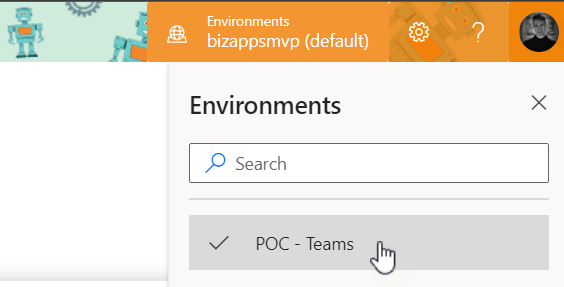
    Sign in, and select the environments menu in the top right and choose the Environment that correlates to your Teams name where you built the Bot.
    My Microsoft Team name is ‘POC – Teams

    Next navigate to the Solutions tab on the left, and select ‘Default Solution


    Once inside the ‘Default Solution‘ we can see many different types of artifacts. To narrow this list down:
    On the top right of the page there is a dropdown with different types. Select ‘Flow

    That’s it. Now we can see all the Flows inside this Teams Environment.

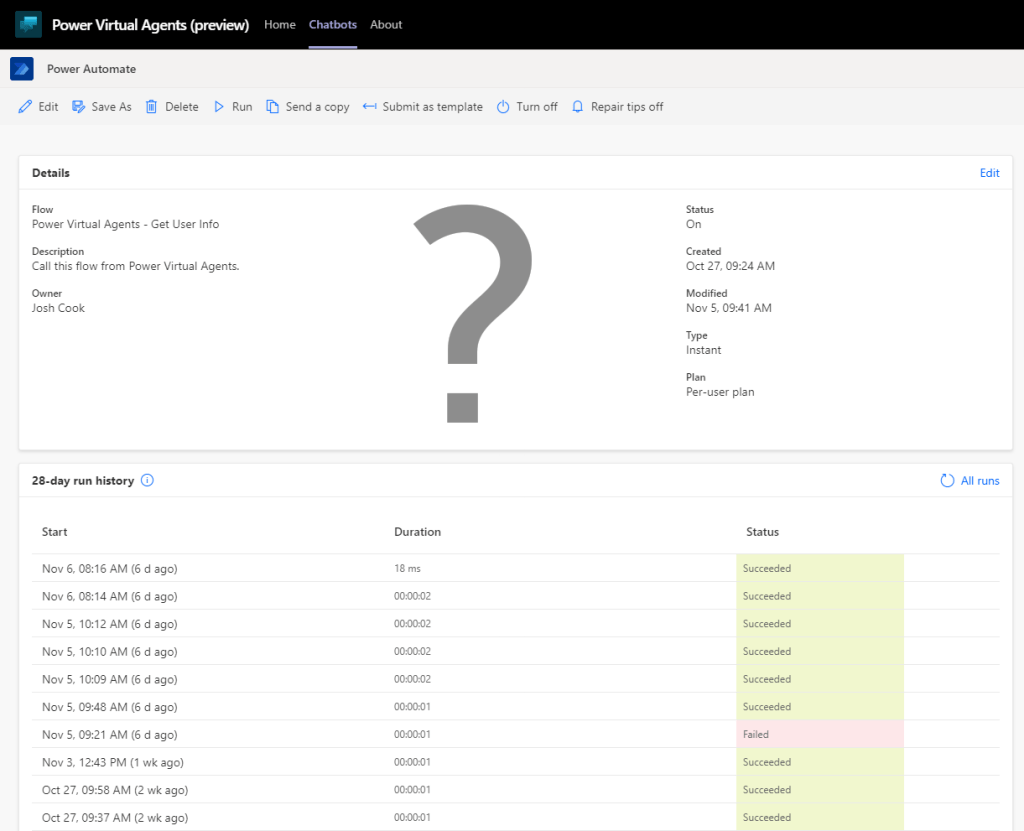
    Want to learn how to get user info from Office365 to use in Power Virtual Agents? Check out my blog on the flow you see above
    Get User Info

    Limitations

    There are some limitations:
    – There is no way to import a Flow into this Environment

    – When using the Save As feature, the Flow is saved outside of the Solution, thus cannot be used for your PVA Bot in Teams

    – When modifying the Flows Inputs and Outputs you will have to remove the Flow action inside of PVA to properly refresh.

    Conclusion

    If you need help with anything Power Platform related, check out the community sites:

    Power Virtual Agents Community – Power Platform Community (microsoft.com)

    Power Automate community (microsoft.com)

    Power Apps community (microsoft.com)

    Home – Microsoft Power BI Community

  • Getting User Details To Use In Power Virtual Agents (Teams)

    Getting User Details To Use In Power Virtual Agents (Teams)

    Things to Know

    This examples is based on building a Virtual Agent in Microsoft Teams.
    We will be using the ‘Only for teams’ Authentication on the bot.

    Summary

    By default PVA in Teams has some valuable variables handy, like ‘bot.UserDisplayName‘. This is awesome, but what if we want more information about the logged in user?

    This post will show both scenarios, on using the bot.UserDisplayName variable as well as getting all the user details that are stored in Office365 like:
    – Email Address
    – First Name
    – Last Name
    – Job Title
    – Etc.

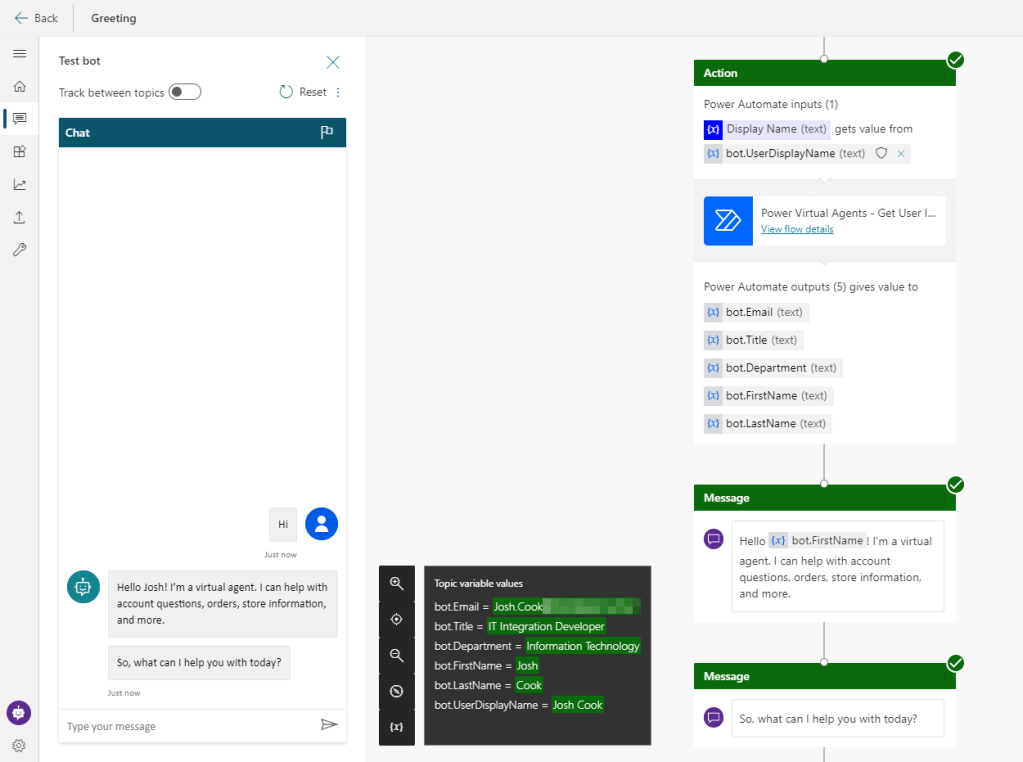
    We can also use this in the Greetings Topic to address the user by their first name, rather than their display name. (Keep in mind this might affect performance by a couple seconds)

    Contents

    Bot Setup
    Scenario 1 (Display Name)
    Scenario 2 (Office365 Details)
    Conclusion

    Bot Setup

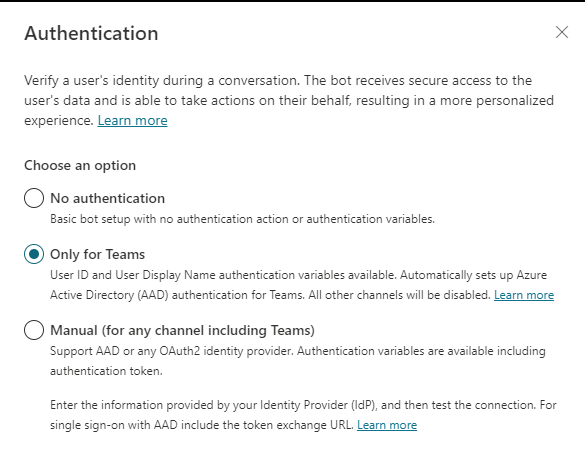
    Once you have your Bot created, make sure the Authentication is set to ‘Only for teams’. To check click
    Manage > Security, Authentication

    For this example we will be using the ‘Only for Teams’ option. This will work for ‘Manual’ as well, but will require additional steps to setup a App Registration in Azure.

    Select ‘Only for Teams’

    Customize Greeting Scenario 1 (DisplayName)

    After enabling the Authentication, you will now have access to Two variables,
    bot.UserDisplayName
    bot.UserId

    Now lets customize our greeting.

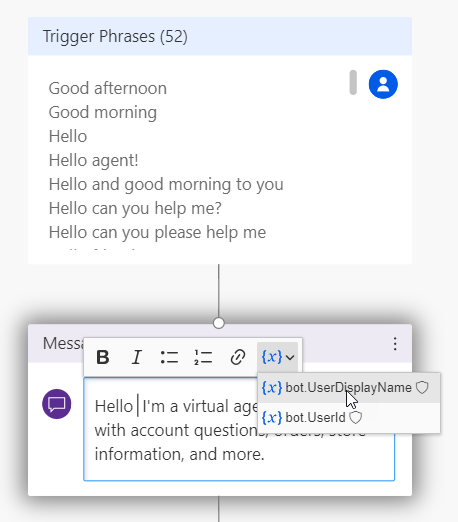
    Navigate to ‘Topics’ and select the ‘Greeting’ Topic, this is under ‘System Topics’. Click on the Authoring Canvas button.

    Inside the message under the Trigger, you can customize the greeting message to include the variable bot.UserDisplayName

    Testing this, the Bot now knows my Display Name. This variable can be used in any topic. Which gives the Bot more of a human type feel.

    To get all the user details from Office365, scenario 2 will cover this

    Customize Greeting Scenario 2 (Office365)

    Navigate to ‘Topics’ and select the ‘Greeting’ Topic, this is under ‘System Topics’. Click on the Authoring Canvas button.


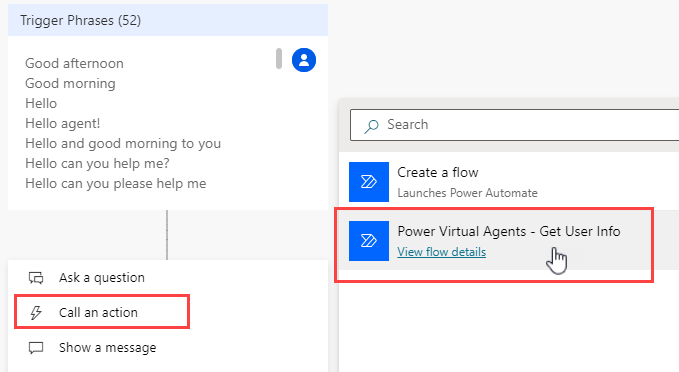
    Under the ‘Trigger Phrases’ and select ‘Call an action’. We will now build a new Flow to get the user details we want.

    You will now be navigated to a new screen where you will build your Flow.
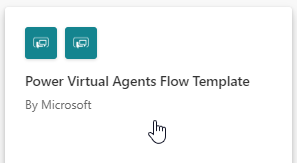
    Select the Basic PVA Flow Template

    First give the Flow a meaningful name. Mine is:
    Power Virtual Agents – Get User Info

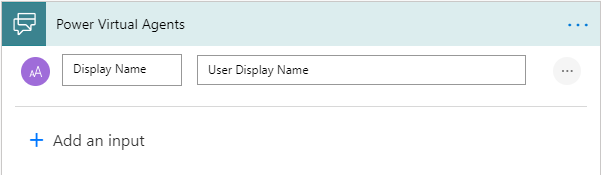
    Add a Text Input to pass in the Display Name variable

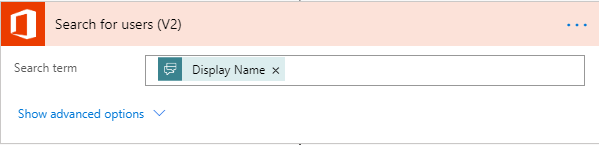
    Next add a ‘Search for users‘ action from office365 connector, and pass in the PVA dynamic value from the trigger

    Now we have all the user details. The results are returned as an Array. To get around this.
    We can add a ‘Get user profile‘ action and pass in the first User Principal Name(UPN)

    We have to use the first() expression, so we don’t get put into an Apply to each loop, my expression:

    first(outputs('Search_for_users_(V2)')?['body/value'])?['UserPrincipalName']
    
    @{first(outputs(‘Search_for_users_(V2)’)?[‘body/value’])?[‘UserPrincipalName’]}

    Lastly in the Return values to PVA action, add all the values you want from ‘Get user profile‘ dynamic content

    Click Save, and close on top right of the screen. Back at the PVA Canvas screen, add your Flow

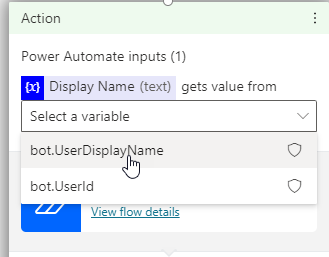
    Pass in the bot.UserDisplayName variable

    Now we can customize our greeting to only address the user by first name

    As a test I created a Topic called User Details

    Conclusion

    This can be a great way to give your bot more personality. Do keep in mind that this may affect performance.

  • Checking If HTML Table Is Empty In Power Automate

    Checking If HTML Table Is Empty In Power Automate

    The Problem

    I needed to check if an HTML table had data or not. Usually when I need to check I have two expressions I go to first.

    1. empty()
    2. length()

    I tried using empty() and found that the HTML table even when empty, is not truly empty.
    I then tried length() and found that when the HTML table is empty there is still a length of 30.

    The Scenario

    I have some data that is used to track different devices that can be loaned out. The data has properties like, Type of device, Serial Number, Etc.

    The data comes in, and looks like this:

    [
      {
        "type": "Phone",
        "device": "iPhone 11 Pro",
        "serialNumber": "0007488"
      },
      {
        "type": "Phone",
        "device": "Samsung Galaxy S20",
        "serialNumber": "1166289"
      },
      {
        "type": "Watch",
        "device": "Apple Watch Series 5",
        "serialNumber": "00013701"
      },
      {
        "type": "Laptop/Tablet",
        "device": "Surface Pro X",
        "serialNumber": "AA78442"
      }
    ]

    I want to put this array of data inside a HTML table and send it out on an email. The problem is, my data might be empty, as only available devices will show up in my data.

    I need to check if the HTML table is empty, if it is empty:
    If True:
    Send email with HTML table
    If False:
    Send email without HTML table

    The Flow

    For this Flow, I will be using an Array Variable to simulate my data coming in from another system.
    I will call this Variable ‘Data‘.
    The HTML table action will be added underneath.
    You will need to determine if you want to use ‘Custom columns‘ or ‘Automatic columns‘ This can be done in the advanced options in the HTML action:

    My ‘Data‘ Variable is empty at the moment. This is what we want for our first run, we want to get the length of the HTML table when its empty.

    Next add a ‘Compose‘ action, and use the expression length(), pass in the HTML table as the parameter. For example, my expression looks like:

    length(body('Create_HTML_table'))
    

    Now run the Flow with no Data in the HTML table, and check your Compose action to see what the length is. In my case it is 30

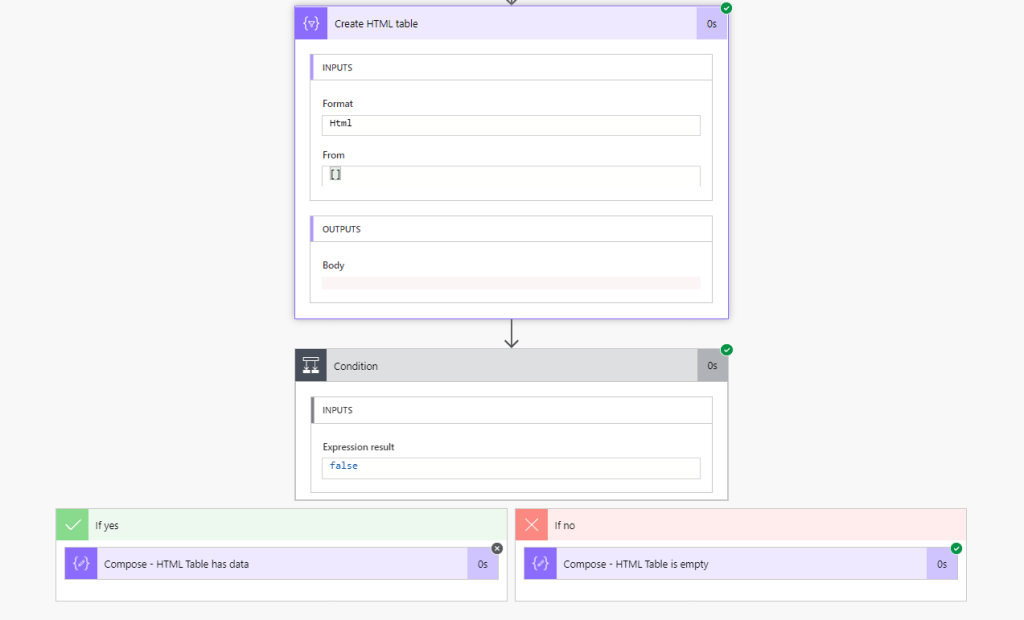
    Now we can add a If Condition to check if the length is greater than 30

    ** TIP **
    I am passing in the Compose action into the condition, this allows me to see what the outputs of the Compose action before it gets evaluated inside the condition. This is extremely useful for troubleshooting

    Conclusion

    The Flow will go into the ‘If yes’ block if the HTML table has data

    The Flow will go into the ‘If no’ block if the HTML table is empty

    Of course checking the Data Variable itself for length could work way better. This example is mainly for data that can come in that could have loads of junk. For example:
    An HTTP API could bring in no data, but still have other information attached like, headers, status code, version. In this case we can only do conditional checks on the HTML table, since our Data variable will always have something being passed in.

    I used this method to help someone on the Community Forum, check it out here:
    https://powerusers.microsoft.com/t5/Building-Flows/Create-a-Flow-with-Condition-that-does-not-send-email-when-list/m-p/721076/highlight/false#M98488

  • Getting Specific Files And IDs In SharePoint Using Power Automate

    Getting Specific Files And IDs In SharePoint Using Power Automate

    Contents

    This post will go over a common problem I have seen using SharePoint action to get a specific file ID.
    There are three parts to this post:
    The Problem
    The Solution
    Conclusion

    The Problem?

    I encountered an issue when trying to filter a a file by filename, that was in a SharePoint document library.

    When needing to get a specific SharePoint file ID. It can be troublesome to filter the Files. For example Using a ‘Get files‘ action we can see that the properties of the file are encased inside {} meaning that SharePoint is using some calculation on the Document Library to create these fields.

    Attempting to use a filter query on any of the fields encased between {} returns an error. For example I am trying to filter the file called ‘Readthis.txt‘ I get a ‘Bad Request’ Error:

    The error message I receive is:

    Column ‘Name’ does not exist. It may have been deleted by another user.
    clientRequestId: 75462fg8-686d-48p1-5se7-e8l97jk84025
    serviceRequestId: 75462fg8-686d-48p1-5se7-e8l97jk84025

    I have read online that using Title as the column name is correct, although I do not get an error, the output is empty.

    The Solution

    Now the best part, the solution!

    The way I have been using to filter out ‘Get files‘ action is by using the ‘Filter array‘ action. This action will allow us to filter the calculated columns that SharePoint is using, like {Name}, {Link}, {FilenameWithExtension}, Etc.

    To get setup, we want the ‘Get files‘ action to pull in ALL files, so we don’t want to have any filter at this stage.

    Now add a ‘Filter array‘ action, put the dynamic content value in the From field. On the left side select the dynamic content from the ‘Get files‘ action. The right side put what you want to filter on.
    So for example, I want to filter and get the file ‘Readthis.txt‘. So my ‘Filter array‘ action looks like this:

    Now when running the Flow, the ‘Filter array’ action is properly filtering out the filename:

    Conclusion

    I wrote this blog post based on a scenario I have helped solved on the Power Automate Community Forum.

    Hopefully someone else find this information useful.

    Thanks for reading!

  • Converting Time Zones Easily In Power Automate

    Converting Time Zones Easily In Power Automate

    Summary

    Did you know that Power Automate has a Date Time action that can easily convert, and format time zones in one action?
    Why is this important? Power Automate natively uses UTC as its time zone, as well as most SharePoint sites. Using an action can be easier than using expressions.

    The Flow

    In this example, we will want to get the current time (this will be in UTC since we will be using Power Automate) and converting the time to local time with a specific format.

    First we want to get the current time, we can use the expression utcNow() but I will be showing how to use the Date Time actions instead.

    The actions are under Date Time:

    Add a Current time action, this action is the same as using utcNow() expression

    Next add Convert time zone action, this action is very useful as it has pre loaded time zones and formats to choose from.

    The inputs for this action are:
    Base time: Use the output from the Current time action
    Source time zone: Make sure to select Coordinated Universal Time
    Destination time zone: Select your local time zone or the time zone you want
    Format string: This dropdown has many ISO formats to choose from. If you want to have a custom format, simply click the drop down and select Enter custom value. See below for examples

    Format Examples

    If for some reason the format you want is not in the dropdown for formats, you can create a custom format as long as it follows ISO 8601 format. To add a custom format click Enter custom value in the dropdown

    Some tips when creating a format for the date ‘2020-10-13‘ (October 13 2020)
    yy = 20
    yyyy = 2020

    MM = 10
    MMM = Oct
    MMMM = October

    dd = 13
    ddd = Tue
    dddd = Tuesday

    Examples:

    yyyy-MMM-ddd = 2020-Oct-Tue
    yy/MMMM/dddd = 20/October/Tuesday
    dddd, MMMM, yyyy = Tuesday, October, 2020
    MMMM dd, yyyy = October 13, 2020
    yyyy-MM-dd = 2020-10-13 (used for comparing dates)

    To add time to your format use the following in your format:
    (It is best practice to add the letter ‘T’ before using time formats)

    h = hours (12 hour time)
    hh = hours (12 hour time)
    HH = hours (24 hour time)
    mm = minutes
    ss = seconds
    tt = Appends either AM or PM to time

    Some examples are:
    MMMM dd, yyyyThh:mm = October 13, 2020T12:51
    MMMM/dd/yyyyTHH:mm:ss = October/13/2020T13:02:41
    hh:mm:ss tt = 01:06:41 PM
    h:mm:ss tt = 12:06:41 PM

    Conclusion

    Knowing these formats and the what each letter code does, the possibilities are endless. You can create any type of custom date time format easily.

    As always if you have any questions, don’t hesitate to reach out.

    Thank you for reading!

  • Power Automate – Limit Runs to Trigger One at a Time

    Power Automate – Limit Runs to Trigger One at a Time

    Summary

    Controlling when your Flow triggers can be crucial. By default Flows run in Parallel, this means multiple runs could be running at the same time, this is great for performance, but could cause troubles in some Flows. For example:

    Lets say we have a Flow setup that is triggered on when an item in a SharePoint list is created, which gets sent to other systems for different purposes. For data quality reasons, we only want the Flow to run one at a time, and have other runs be waiting in a queue.

    The Flow

    The only setting we need to change is in our Trigger.

    This can be done on Triggers other than SharePoint

    For this demo, I added a Compose action to get the Name of the item being created in SharePoint.

    I added a Delay action only to show what happens if multiple runs queue up.

    The setting we want to change is in the trigger, click the 3 dots on the trigger and select Settings from the drop down.

    Now inside Settings, find and enable Concurrency Control, and set Degree of Parallelism to 1. This setting is how many runs can run in at one time. Click Done

    My trigger is When an item is created, so I will create 3 items, one every 15 seconds to show what happens with queued runs.
    1st item = Run1
    2nd item = Run2
    3rd item = Run3

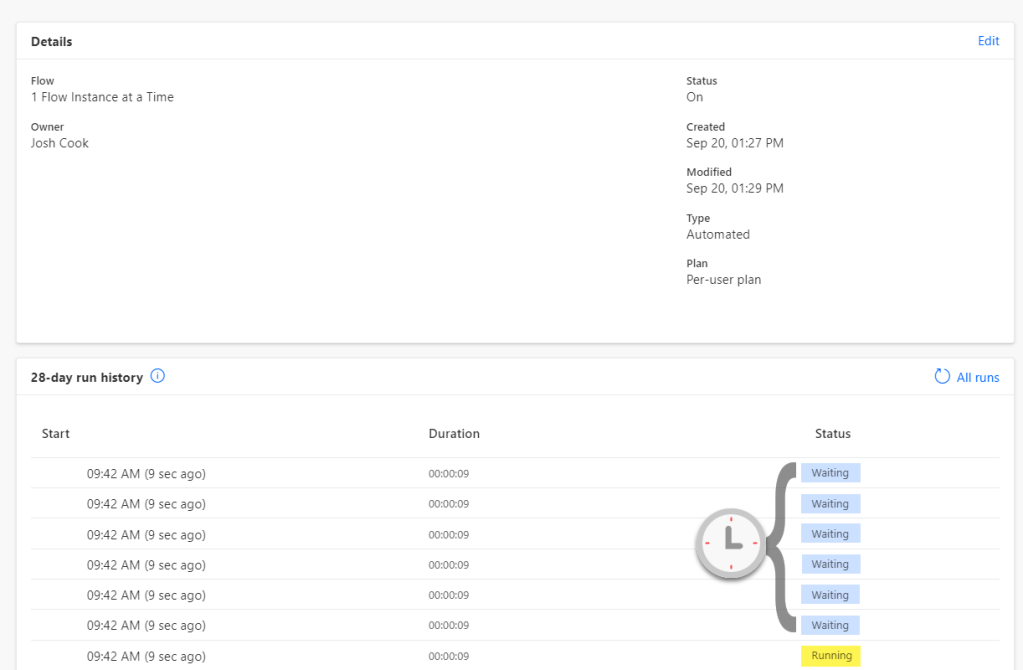
    Here are my findings:

    As we can see the runs are not in order, of the way I created the items. So we can conclude that if we create the items faster than our trigger time, we can expect that the Flow will not run in a sequential order.

    Conclusion

    As we can see above, this Trigger setting is very useful when needing to limit the Flow to run one at a time.
    But the limitation on this is, if the Flow is being triggered multiple times and having the runs queue up, there is a chance that the runs will not run in order.