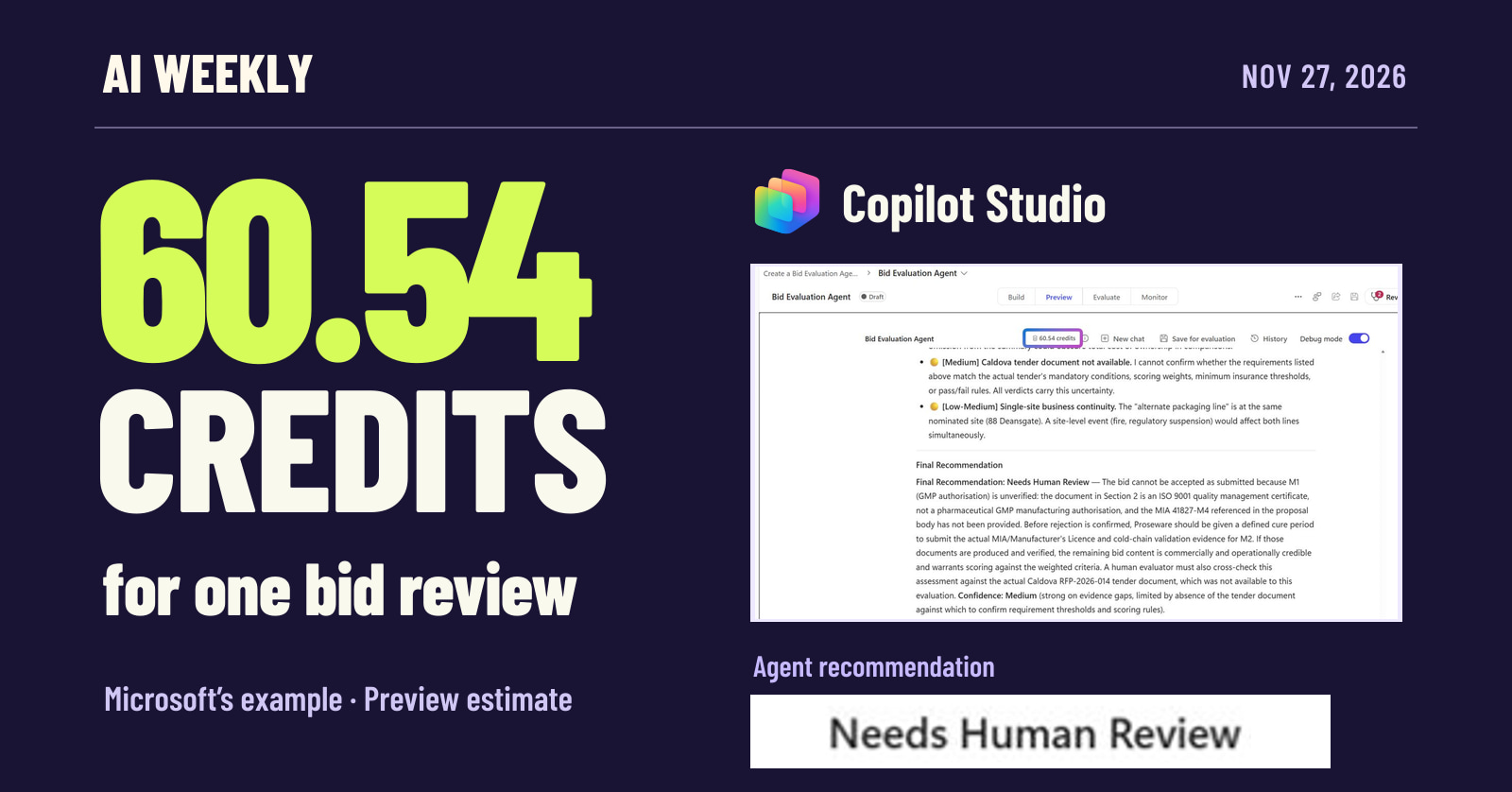
Microsoft’s bid evaluation agent reached 60.54 estimated credits and recommended human review. It could not verify the bid against the original tender document. That is the first example I would show someone asking about Copilot Studio agent costs. You can see what the run used and what the buyer still has to do.
When I reviewed July usage for one Cowork tenant, one day topped 12,000 credits. The monthly chart could show me the spike. In Copilot Studio, a maker can get much closer to the work by checking an individual test conversation. Microsoft’s November 24 guide walks through how.
November 27, 2026 edition. News checked through Friday afternoon in Edmonton. Catch up on last week’s Autopilot and Today edition.

This week in 60 seconds
- Copilot Studio agent costs. Compare two test runs and see which step is worth changing.
- Autopilot’s monthly charge. An agent with its own mailbox and OneDrive starts at 100 Copilot Credits a month for those resources. Its activity is metered separately.
- Dataverse and Fabric. Cross-region links are generally available. An existing link can also get a new connection as the update rolls out.
- Copilot in Excel. People who can only view a workbook can now start asking Copilot about the numbers as the feature rolls out.
- GitHub Copilot code review. There is a December 30 billing change for organizations that have left the policy at its default.
- Agent access. Google set a February deadline for Workspace agents. Claude can now load instructions from the server that supplies a tool.
- Gemini and Claude. Give Gemini one worksheet range, or give a Claude artifact its own desktop window.
- Five more releases. GPT-6.2 in Chat, checkout through ChatGPT, searchable websites, local model weights and video with sound.
- A proof you can check. Independent researchers ran the checks on a Claude-assisted proof of the Riemann Hypothesis.
1. Measure Copilot Studio agent costs one task at a time
Take an agent that looks up a customer order. Give it a valid order number. Then try a request where two customers have the same name. Both chats might end with the right delivery date, but the second one could take another question and another lookup. I would want to see both runs before putting a price on an order inquiry.
For agents using the Microsoft Copilot harness, Preview shows a running credit estimate while you test. Evaluate lets you compare individual conversations in a test set. The grader uses credits too, so keep that one-time evaluation cost out of your production forecast. Once the agent is live, check the reported consumption after the billing data comes through. Where the credit estimates appear.
Here is the number I would keep for the pilot. Add up the credits used by all the attempts, including the retries. Divide by the number of orders the agent actually resolved. A shorter conversation saves very little if the service desk still has to look up the order. Microsoft’s November 24 guide shows how to turn a mix of easy lookups and longer jobs into a monthly forecast.
Which spending policy pays for the agent?
On the admin side, Agent 365 spending policies for individual resources and environments are in public preview. When a Microsoft 365 admin center policy covers an environment, that policy takes precedence over its Power Platform admin center billing setup. Start with one pilot environment, check the funding source and name the person who gets the alert. Selecting All environments makes that a much bigger change. How Microsoft applies the policy.

There is one detail I would check before moving an environment. Does an agent flow use an AI Builder prompt to read a document or classify a request? Microsoft says these resource policies exclude AI Builder usage and advises keeping workloads that depend on it on their existing setup.
2. An Autopilot mailbox has its own monthly charge
Last week I covered what Autopilot can do in Teams and Outlook. This week the first US preview reached its listed start date, with a monthly cost worth putting next to that demo. Microsoft lists November 24 as the Frontier public preview date for Microsoft 365 Resources for Agents with Autopilot, initially for eligible US customers. The agent gets its own account, email address, mailbox, calendar and OneDrive workspace.
Those persistent resources cost 100 Copilot Credits per supported agent per month. Ten provisioned Autopilots would use 1,000 credits a month for that line alone. Sending mail, using tools and running models add consumption. If I were pricing a pilot, I would put the standing charge on its own line so a quiet week is easy to explain. Microsoft lists December 1 for the corresponding Copilot Studio, Sales Development Agent and Service Agent previews. Microsoft’s availability and billing table.
3. Change the connection behind a Dataverse link to Fabric
Imagine the person who set up your Dataverse link to Fabric moves to another team. The nightly reporting still depends on their connection. Microsoft is rolling out an Update connection command on the Fabric link details page. Pick another connection, or create one that uses the Fabric workspace identity where available. The existing sync carries on. Microsoft expects the command across regions by the end of November.

A second change is already generally available. A Dataverse environment can now link to a Fabric workspace in another region. If your analytics team already has a workspace in the region your organization approved for reporting, you can use it even when the source environment sits elsewhere. The two Link to Fabric changes.
4. Ask about a workbook you can only view
Someone shares the Friday sales workbook with you as read-only. You just want to know which region missed target by the most. Copilot in Excel is rolling out the ability to ask that question in the shared workbook on Windows, Mac and the web. Ask it to name the worksheet and show the actual and target figures. You can check the result with the same access the owner gave you.
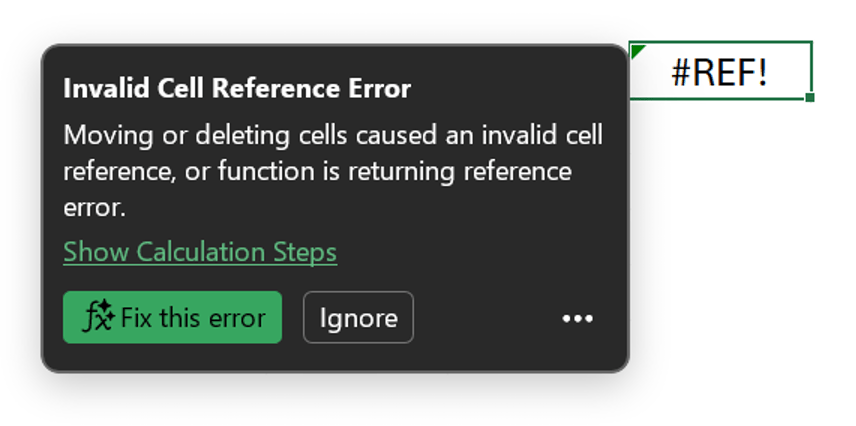
For the person maintaining the workbook, Excel on Windows is also getting more descriptive formula error cards. Hover over the cell’s error indicator and select Show Calculation Steps to trace the broken reference. That update is rolling out in Windows version 2611, build 16.0.20625.20000 and later.
There is also a change in the Excel model picker. GPT-6.2 Sol is available there, and Frontier users can see additional choices, including GPT-6.2 Astra and Claude Fable 5.2, when their admin enables usage-based billing and allocates credits. I would start the sales question with the model already available to the team. One subtraction per region is a pretty good reason to keep it simple. The Excel team’s November update.
5. Check who pays for GitHub Copilot code review
If your team uses GitHub Copilot to review pull requests, check who pays before December 30. In eligible Business and Enterprise organizations, GitHub will start billing the repository owner’s organization when a licensed member requests a review and the policy is unset. Select Member to keep using the requesting member’s entitlement. GitHub will honor an existing explicit choice.
This applies to organizations eligible for paid AI Credits usage. GitHub lists exceptions for accounts with a billing lock, paid AI Credits usage disabled or no billable customer. If the enterprise owns the policy, the enterprise owner makes the choice. GitHub’s November 25 billing notice.
What happens after the review?
Anthropic introduced Claude Ship on November 23 for GitHub repositories on Claude Team and Enterprise. Code Review is generally available. PR Steward, which can fix failed checks and respond to review feedback, and Claude Approvals, which reads a policy stored in the repository, are in beta. A useful first trial is to let the policy record which changes it would approve. Compare those calls with the human reviewer’s decisions before letting it approve changes. Token charges can still apply in observe mode. Claude Ship’s controls and billing.
One package worth checking. If you build Python agents, check your lockfile or build history for agent-framework versions 1.26.1 and 1.26.2. Two unauthorized releases reached PyPI on November 17 and were removed. Microsoft published steps this week for teams that installed either version, including rotating exposed credentials. Microsoft’s November 25 advisory.
6. Google sets rules for Workspace agents and Claude gives tools an instruction manual
If an agent can read a Google Doc and email a copy to a supplier, who gets to approve the second step? On November 24 Google announced general availability for its Workspace Model Context Protocol (MCP) servers and official command-line interface. An admin can require a person to confirm actions such as sending an external email or changing who can open a Drive file.
There is a date here for anyone maintaining an integration. Google says it will start technically enforcing the requirement for AI agents to use its Workspace MCP servers or CLI on February 1, 2027. An ordinary app that calls a REST API and an external AI agent using that API are different cases under Google’s rules. I would inventory the agents that touch Gmail or Drive now and put an owner next to each one. Google’s rollout and enforcement dates.
Anthropic tackled the other end of that connection. A server can now give Claude both a tool and the instructions for using it. Think of an expenses tool that can look up a receipt. The skill could explain which field carries the tax and when to ask for a clearer copy. Skills over MCP is in public beta for Claude and Claude Code. Pro, Max and Ultra have it on by default, Team admins can enable it, and Enterprise support is still ahead. Anthropic’s availability by plan.
Two related features reached general availability for Pro, Max and Ultra. Anthropic is rolling them out to Team and Enterprise. Tasks lets a server finish a longer job in the background. Elicitation lets it ask the person for a missing detail. If you run agents on AWS, there is also a way to find undocumented MCP endpoints behind supported gateways and load balancers. AWS endpoint discovery and regional availability.
7. Gemini reads a range of cells and Claude puts an app on your desktop
Give Gemini the cells behind the variance
Google added file slicing for Gemini 4 in the Gemini API on November 23. Upload an Excel workbook once, then specify the worksheet and cell range Gemini should inspect. You can ask for the calculated values first and the underlying formulas on a second pass. You pay input tokens for the parts it inspects. For a November variance report with twelve tabs, that means you can start with the one row finance actually asked about. Google’s file slicing examples.

Put a Claude artifact on the desktop
An artifact you use every morning can now have its own icon and window. Anthropic began rolling out Install as app in beta on Mac and Windows on November 24. Edits to the underlying artifact update the installed app. Imagine sharing an intake tracker with a colleague and fixing the sort order once for both of you. Claude asks for permission again after each app update, including edits you make yourself. How installed Claude apps work.

8. Five more releases worth a look
- ChatGPT. On November 23 OpenAI began rolling a conversation-tuned version of GPT-6.2 Sol into the Chat tab for Plus, Pro, Business and Enterprise. An Enterprise admin’s settings determine access. Last week’s Work and Codex release was a separate rollout. ChatGPT release notes.
- Shopify. On November 23 eligible merchants gained agentic checkout through ChatGPT. A shopper’s agent uses the store’s Shopify checkout and the order lands in the merchant’s usual admin. If your store automatically enables new channels, check the setting. Shopify says it honors existing opt-outs. Shopify’s merchant settings.
- Cloudflare. The November 25 Search for Agents beta gives a site its own search endpoint. An agent can request a passage from your documentation and get the matching text back in Markdown. Website owners can enable it on any plan, with AI Search pricing and limits. Cloudflare’s release notes.
- Local AI. PrismML released downloadable weights for Ternary Bonsai 2.5 27B on November 24. The model itself occupies 5.9 GB. That is a useful starting point for a local document assistant, though the running application needs memory too. PrismML’s model and hardware details.
- Video. Sand.ai’s November 24 MAGI-2 release can generate up to 30 seconds of 1080p video with synchronized dialogue, effects and music. Its demo shows a single shot passing through five art styles. Sand.ai offers a hosted model and says an open release will follow. Watch Sand.ai’s examples.
9. How do you check a Claude-assisted proof?
Just after last week’s cutoff, mathematician Levent Alpöge released a proof of the Riemann Hypothesis that he developed with Claude. The hypothesis concerns a pattern in a mathematical function tied to the distribution of prime numbers. What caught my attention was how other people could check the work. Alpöge published the proof in Lean, a language that lets software verify each logical step. The Lean and Mathlib teams’ verification statement.
A valid proof of a slightly different theorem would be a very expensive wrong answer. Reviewers compared the statement itself with the one in the public math library, then checked the proof. MIT mathematician Andrew Sutherland published the commands, results and timing. One independent comparison finished on November 25 after more than five days. Sutherland’s verification log.
Back in Copilot Studio, I would borrow a much smaller version of that idea. Give the bid agent one case with the tender attached and one without it. Write down what a buyer should receive in each case before running either one. A request for human review can be exactly right when the tender is missing. Now the credit estimate tells you what it cost to get the outcome you actually wanted.
Leave a Reply