I’ve been at PPCC all week, and keeping up with everything outside the conference has been a challenge. There was a LOT to catch up on in this week’s Microsoft AI updates.
October 30, 2026 edition. Research checked through October 29, plus a clearly dated October 22–23 catch-up on updates absent from the previous edition.
Cowork building Dataverse apps. An authoring agent inside Canvas Studio. Microsoft opening up its shared Copilot harness. GitHub orchestrating models, adding memory and expanding how agents work. Then, on Thursday, a new finance package for Cowork.
This is exactly why I started the weekly recap. Here are the announcements worth catching up on, with the release status and the details that change what you can actually use.
Table of contents
- Microsoft AI updates: this week in 60 seconds
- 1. Cowork builds an app on Dataverse
- 2. Dataverse adds reusable business context and operations
- 3. An authoring agent is now inside Canvas Studio
- 4. Microsoft opens up its shared Copilot harness
- 5. Cowork gets a finance package
- 6. GitHub Copilot Fusion chooses and combines models
- 7. GitHub agents get more context, memory and team ownership
- 8. GitHub changes workflow execution, authentication and billing
- 9. Copilot Credits now have a Graph management surface to investigate
- 10. Copilot Studio adds delivery and collaboration improvements
- 11. Frontier expands beyond Copilot
- 12. More releases worth knowing about
- 13. Oracle and ServiceNow extend the business-app story into ChatGPT
- 14. Google opens another route for connected applications
- 15. Five late updates from last week
- 16. The operational updates to check before next week
- 17. Dynamics 365 and government-cloud rollout notes
- 18. Two stories about operating agents
- 19. PPCC becomes Maker Con
Microsoft AI updates: this week in 60 seconds
- Cowork can build Dataverse-backed apps. Microsoft’s new demonstration covers the data model, business logic, approvals and app. App creation requires Frontier and uses Managed Runtime preview.
- Canvas Studio gets an authoring agent. It can edit screens, controls and Power Fx. The current preview is US-only, English-only and billed through GitHub.
- Microsoft Copilot harness becomes a shared platform story. Foundry gets a public preview, while Copilot Studio publishes internal evaluation results against its Standard harness.
- Cowork gets Finance and Capital Markets plugins in GA. Accounting capabilities in Cowork and Excel are available through Frontier.
- GitHub Universe brings Fusion, Memory and Agentic Workflows. Local model routing, Dreaming and several app capabilities have separate preview labels.
- Copilot billing and ownership need a closer look. New Enterprise access has no included monthly AI-credit allowance; SDK organization authentication and shared Automations change who owns and pays for work.
- Microsoft 365 Frontier expands in November. Outlook, OneDrive, SharePoint and Teams previews join the program.
- The admin dates are close. October 30 for the revised federated-connector governance change; November 1 for the Canadian time-zone changes described by Microsoft.
1. Cowork builds an app on Dataverse
Microsoft’s October 28 demonstration starts with an event-registration request and follows it through to a working application. Cowork creates related tables, reuses Contacts, adds sample records and implements capacity and waitlist behavior. The Microsoft Dataverse plugin supplies skills for modelling, records, business logic, security and solutions. Microsoft’s walkthrough.

The connection uses the signed-in user’s Dataverse permissions, and changes are presented for approval. The app-building experience needs Frontier, and the finished app runs in Copilot Managed Runtime (preview). That is a specific application type and hosting path; a Dataverse backend alone doesn’t tell you whether an app is canvas, model-driven or a Cowork managed app.
This is the one I want to put through a proper build. Start with an existing schema, make it reuse the right tables, then test the resulting app as an ordinary user. A successful build needs to survive permissions, validation and the next release.
There are several similarly named integrations here:
| Integration | Job to understand |
|---|---|
| Microsoft Dataverse plugin in Cowork | Modelling, records, business logic, security and solution skills for a selected environment; Cowork supplies the app-building flow. |
| Business Applications in Work IQ / Business apps (preview) | Business context and authorized actions across existing Dynamics 365 and Power Apps data. |
| Dataverse plugin for coding agents | A separate installation and development workflow in supported coding tools. |
Microsoft’s October 23 Dataverse announcement and Cowork Work IQ guidance explain those different entry points. Check the actual plugin name when following a demo.
2. Dataverse adds reusable business context and operations
The October 23 announcement landed after the previous weekly’s cutoff, and it deserves space here. Microsoft describes public-preview improvements to Business Skills, including agent-assisted authoring, version history and access management. It also extends business context through Work IQ in Copilot Studio and highlights the Dataverse Ask APIs. Announcement.

Dataverse Ask, in preview, lets an application ask a natural-language question over a defined semantic model. A request can return structured records and supporting information while respecting the caller’s permissions. You still configure the environment and select the relevant tables; indexing consumes Dataverse database storage. Ask overview and setup requirements.
For example, a semantic model could bring Accounts, Opportunities and Cases together for questions about customers with unresolved issues and upcoming renewals. I’d compare the answers with a known query result before trusting the summary.
Then, on October 26, Microsoft published the detailed launch of Custom API invocation through the Dataverse MCP server. An agent can discover an operation, inspect its typed inputs and invoke existing server-side business logic. Microsoft’s example keeps several related writes within one Dataverse transaction. Legacy Custom Actions are not currently supported. Custom API announcement.

That is a useful way to expose a business operation with its rules intact. Define what “submit this request” means in Dataverse, then let an authorized agent call it.
3. An authoring agent is now inside Canvas Studio
The October 27 Power Apps announcement brings agentic authoring directly into the editor. Describe a change, review the proposed plan and let the agent work on screens, controls and Power Fx. It can work with an existing canvas app, which makes this particularly interesting for the apps we already maintain. Announcement.

Read the preview limits before planning a demo: US-only and English-only. Administrators enable Agentic Coauthoring in Power Apps using GitHub, and the maker connects a GitHub account. Usage is billed through GitHub. Needed data sources must already be available; the agent cannot independently add data sources, save, publish or share the app. Current setup and limitations.
The external canvas-authoring plugin was already available. This week’s change is the agent working directly inside Studio. For Canadian makers, the region restriction is a meaningful detail.
4. Microsoft opens up its shared Copilot harness
On October 28, Microsoft introduced the Microsoft Copilot harness as the shared foundation behind multiple agent experiences. A harness manages the work around the model: context, tools, execution and the steps needed to keep a task moving. Microsoft is making that foundation available to developers through Foundry in public preview, with a managed runtime or SDK path. Company announcement and Foundry announcement.
The same Foundry announcement separately makes long-running resilience for hosted agents generally available. Application code still needs to save progress and prevent duplicate actions when work restarts. Foundry harness-runtime billing begins December 1; model inference, tools and connected services can still incur charges during the earlier runtime-free period. Keep those distinctions in the pilot budget. Resilience and pricing.
In Copilot Studio, the GitHub Copilot harness is being renamed Microsoft Copilot harness. Existing agents continue working; the rename itself changes neither capabilities nor billing. Microsoft’s Studio article also supplies some useful internal evaluation results:
| Internal evaluation measure | Microsoft-reported result versus Standard harness |
|---|---|
| Pass rate with an OpenAI model | +10.8 percentage points |
| Pass rate with an Anthropic model | +22.1 percentage points |
| Continued attempts after failed tool calls | 84–91%, compared with under 7% |
These are Microsoft’s evaluated workloads and configurations. Continuing after an error is not the same measure as completing the task, and a benchmark improvement is not a promise about your agent. Studio announcement and evaluation discussion.
The part I want people to pay attention to is how much the surrounding system can change the outcome. When comparing agents, record the harness, tools, context and permissions alongside the model name.
5. Cowork gets a finance package
Microsoft’s October 29 announcement introduces more than 25 finance skills and partner-built plugins across Copilot. The two headline Cowork plugins, Finance and Capital Markets, are generally available. Accounting capabilities in Cowork and Excel are available in Frontier. Official finance announcement.

The work spans close-review packages, variance investigations, forecast inputs, investment research, financial models and sourced investment materials. Accounting scenarios include reconciliations and draft journal entries. Preparing a journal entry doesn’t establish autonomous posting into an ERP. Finance professionals retain the decisions and approvals, and partner services can require their own access and subscriptions.
My first test would use a small close package with a deliberate discrepancy and a missing assumption. Does the agent catch them? Can the reviewer trace each number back to the source? Show those checks alongside the finished presentation.
6. GitHub Copilot Fusion chooses and combines models
Copilot Fusion reached GA on October 28. Choose Standard, High or Max effort, and Fusion can select a model, escalate through a cascade, or combine models for critique and revision. Organization model policies still apply. Billing covers the models invoked, so multi-model execution needs a cost comparison as well as a quality comparison. Fusion release.

The separate local-model routing feature is an experimental preview. Supported Windows devices can use managed MAI Code 1.1 Flash models through Windows ML; the CLI also has supported manually configured local-model options. Routing still depends on cloud services, so this does not make the session fully offline. Local-routing release.
This is worth a controlled comparison: same repository, same task, same acceptance checks. Record completion quality, elapsed time and total billed usage. Device support and local-routing behavior need an actual test before making a hardware recommendation.
7. GitHub agents get more context, memory and team ownership
The October 28 Universe package includes Projects and desktop computer use in public preview in the GitHub Copilot app. Projects organize related context and agent work. Computer use can interact with approved applications on Windows and macOS, including applications without an API. Permission modes and saved approvals affect how execution proceeds. This is the GitHub Copilot app announcement. App release.
Copilot Memory is GA on paid plans; Dreaming is an opt-in public preview. Memory carries useful preferences and repository conventions between sessions. Dreaming curates that context and can propose changes to repository skills and instructions through pull requests. Dream runs consume AI credits. Memory and Dreaming.
Shared Copilot Automations are rolling out. They can belong to a repository, remain available when their creator leaves and bill the repository owner. Access and organizational policy still govern who can view, edit and run them. Shared Automations.
That ownership change is useful. If a recurring task becomes part of the team’s delivery process, the team needs to own its instructions, access and budget.
8. GitHub changes workflow execution, authentication and billing
Agentic Workflows reached GA on October 28. Markdown-defined work compiles into GitHub Actions workflows, with read-only defaults, sandboxing and controlled outputs. An obvious Power Platform use is investigating a failed solution build and returning evidence for the person fixing it. GA announcement.

The Copilot SDK gained organization-owned authentication in public preview on October 27. An installed GitHub App can use a short-lived installation token, with organizational model policies and budgets. This gives supported SDK workloads an identity that doesn’t depend on an employee’s personal login. Server-to-server authentication.
And here is the billing detail to catch: the new GitHub Enterprise Copilot-access option includes no monthly AI-credit allowance per user. Eligible Enterprise Cloud customers can arrange access through their account team, with self-service following later. AI usage is metered against the enterprise budget from the first request. Completions and next-edit suggestions can continue without a budget; Chat, code review and cloud execution need available budget. Existing Copilot Business and Enterprise plans remain available. Enterprise access announcement.
Access, execution identity and consumption are three separate parts of the rollout. Check all three before turning a useful experiment into a shared service.
9. Copilot Credits now have a Graph management surface to investigate
Microsoft’s Copilot Cost Management API is documented under /beta/copilot/costManagement. It covers balances, spending policies, assignments and related controls. This is useful for anyone trying to build an administrative view of who can consume credits and what remains. API overview.
It is beta and not supported for production applications. A balance and policy API is also different from a complete historical billing report. Don’t assume it supplies invoices, dollar costs or every consumption detail you need.
I’d start with a read-only prototype that shows the available balance and relevant spending policies, then compare it with the supported admin reports. This is a newly surfaced capability in the weekly, not a claim that Microsoft announced a GA API on Monday.
10. Copilot Studio adds delivery and collaboration improvements
Microsoft’s notice MC1518233, published October 21, scheduled enhanced Copilot Chat agent support for GA on October 26. It lists Topics, connected agents, evaluations, monitoring, a native Chat preview with Activity Map, and lifecycle management across development, test and production. The notice supplies the milestone; tenant completion wasn’t independently tested for this article. Message Center notice, with an accessible public copy.
Separately, Microsoft’s live roadmap marked maker sharing for the Microsoft Copilot harness as Launched on October 28. Its description distinguishes Agent Viewer, for analytics and evaluations, from Editor, which includes changes and publishing. Roadmap 569475.
The sharing documentation still describes a narrower new sharing experience, so check the controls in your tenant. Test the handoff with separate reviewer and editor accounts before deciding which role your customer needs.
11. Frontier expands beyond Copilot
Microsoft announced on October 26 that Frontier will expand to eligible new Outlook for Windows, OneDrive, SharePoint and Teams previews starting in November. Existing Frontier users don’t need to enroll again. Enrollment itself doesn’t require a Copilot license, although individual features still need their applicable licenses. Frontier announcement.
Targeted Release users aren’t automatically enrolled. Microsoft’s separate retirement guidance says enrollment changes freeze in November and Targeted Release retires in January 2027. If your organization has a pilot group, review who belongs in it and how preview access is assigned before the new program expands.
12. More releases worth knowing about
These deserve a place in the catch-up even if they don’t each need a full article.
| Update | What to keep straight |
|---|---|
| GPT-6.1 Terra in GitHub Copilot | October 26 GA announcement with gradual rollout. This is new availability in GitHub Copilot; model policy and usage billing apply. |
| Claude cost attribution in Foundry | October 27 GA announcement. CCU-billed Claude usage can be attributed to its Foundry resource in Azure Cost Management. Resource-level attribution is not project-level cost tracking. |
| MAI-Image-2.6 and Flash in Foundry | October 27 GA. More image-generation and editing options, including multi-reference editing. Adobe Firefly support is still coming soon. |
| GitHub plugin controls | October 28 GA. Repository defaults and enterprise-required or blocked plugins bring more control to shared development setups. |
| Image generation in GitHub Copilot | October 28 public preview. Image tokens have their own billing and count toward AI credits. |
| Copilot app security extension | October 28 public preview. Bring alerts and local review into the app; scanning access, licensing and permissions still apply. |
| Copilot metrics by client | October 23 adds visibility into tools using Copilot as their model provider. It doesn’t measure every independent Codex or Claude subscription; client attribution is best-effort. |
| GitHub in Teams | October 23 update connects notifications to investigation and proposed code changes. The separate legacy app retires November 16. |
| Dataverse node for n8n | Highlighted in Microsoft’s October 23 bundle. Supports row operations for standard and custom tables; it is another integration option for existing Dataverse data. |

13. Oracle and ServiceNow extend the business-app story into ChatGPT
OpenAI and Oracle announced their expanded partnership on October 27. Oracle is developing AI Workspace integrations for business information and approved workflows in ChatGPT, alongside offerings such as App Composer. The announcement describes developing and planned experiences; it does not make every Oracle workflow generally available in ChatGPT. Oracle announcement.
On October 28, OpenAI and ServiceNow announced their expansion. The ServiceNow MCP plugin is available now in OpenAI’s marketplace, with enhanced functionality planned. Codex integration into ServiceNow’s AI Workflow Factory is expected in 2027. ServiceNow announcement.
My read is that business context and approved actions are becoming central to the competition. Microsoft has Work IQ and Dataverse. Other vendors are connecting their systems too. The useful comparison is which records an agent can reach, what it can change and how the organization controls that access.
14. Google opens another route for connected applications
Google’s Connected Apps Platform, announced October 28 in preview, gives developers a path to connect applications with Search and Gemini using mechanisms including MCP. Access is opening in phases, so this is not an unrestricted GA rollout. Connected Apps announcement.
Google also announced Genie 4 on October 27, with interactive world simulation, native audio and natural-language steering. Access is initially limited to trusted testers; broader Project Genie and API access are described as coming soon. Genie 4 announcement.
For enterprise builders, Connected Apps is the more immediate architecture story. Genie 4 is one to watch as access expands.
15. Five late updates from last week
These are October 22–23 announcements that didn’t make the previous edition. They belong in the catch-up, with their actual dates attached.
OpenAI Decisions API reached GA on October 22. It uses GPT-6 Luna for bounded decisions such as classification, routing and scoring, returning a probability, a choice from supplied options or a score. Your application decides what to do with the result. Announcement and API guide.
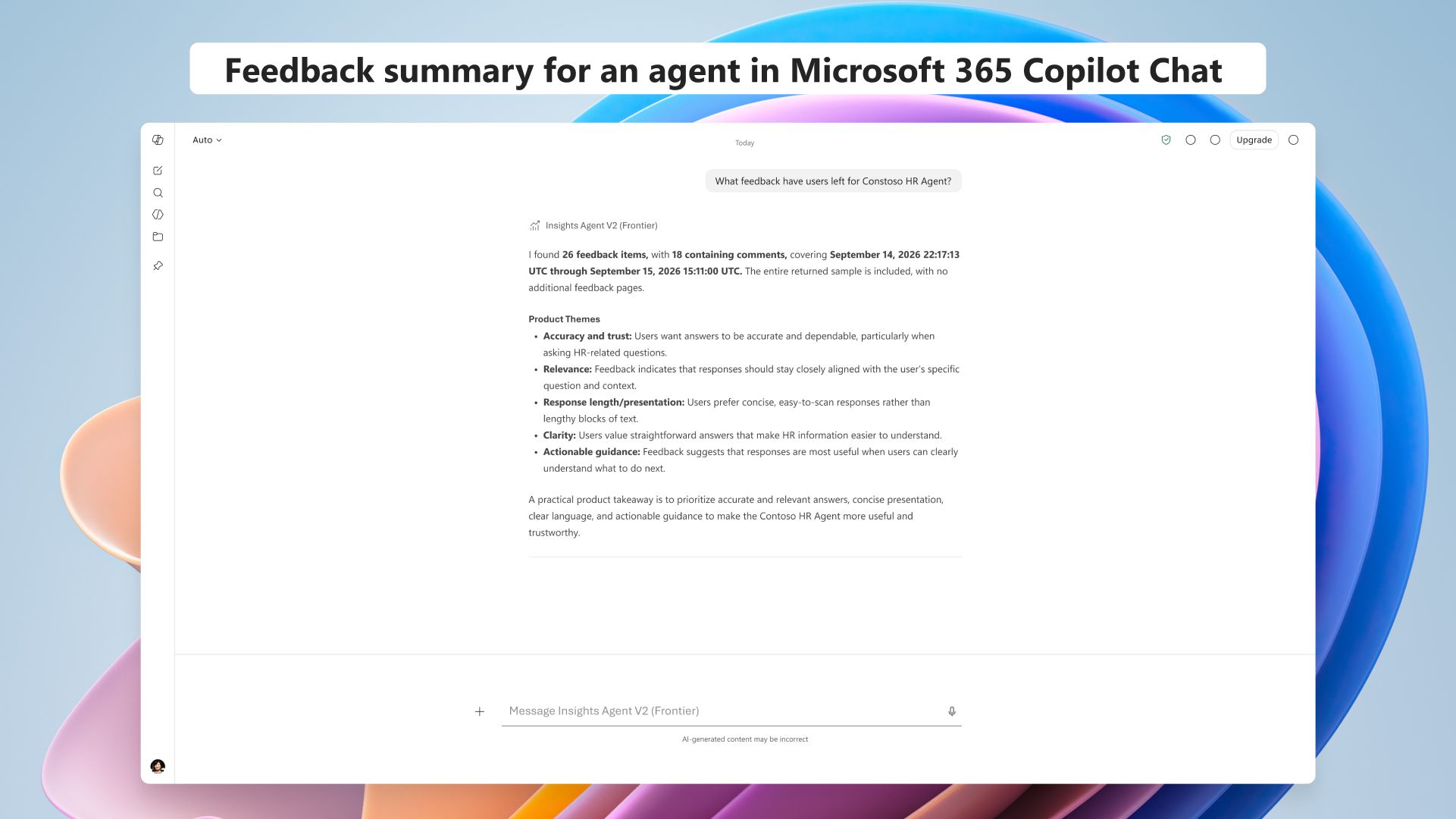
Insights Agent V2 adds feedback analysis in Frontier. Microsoft’s October 22 article shows agent owners exploring ratings, original comments and recurring themes in Copilot Chat. Administrators must enable feedback sharing. This is an early-access preview, separate from existing usage analytics. Insights Agent announcement.
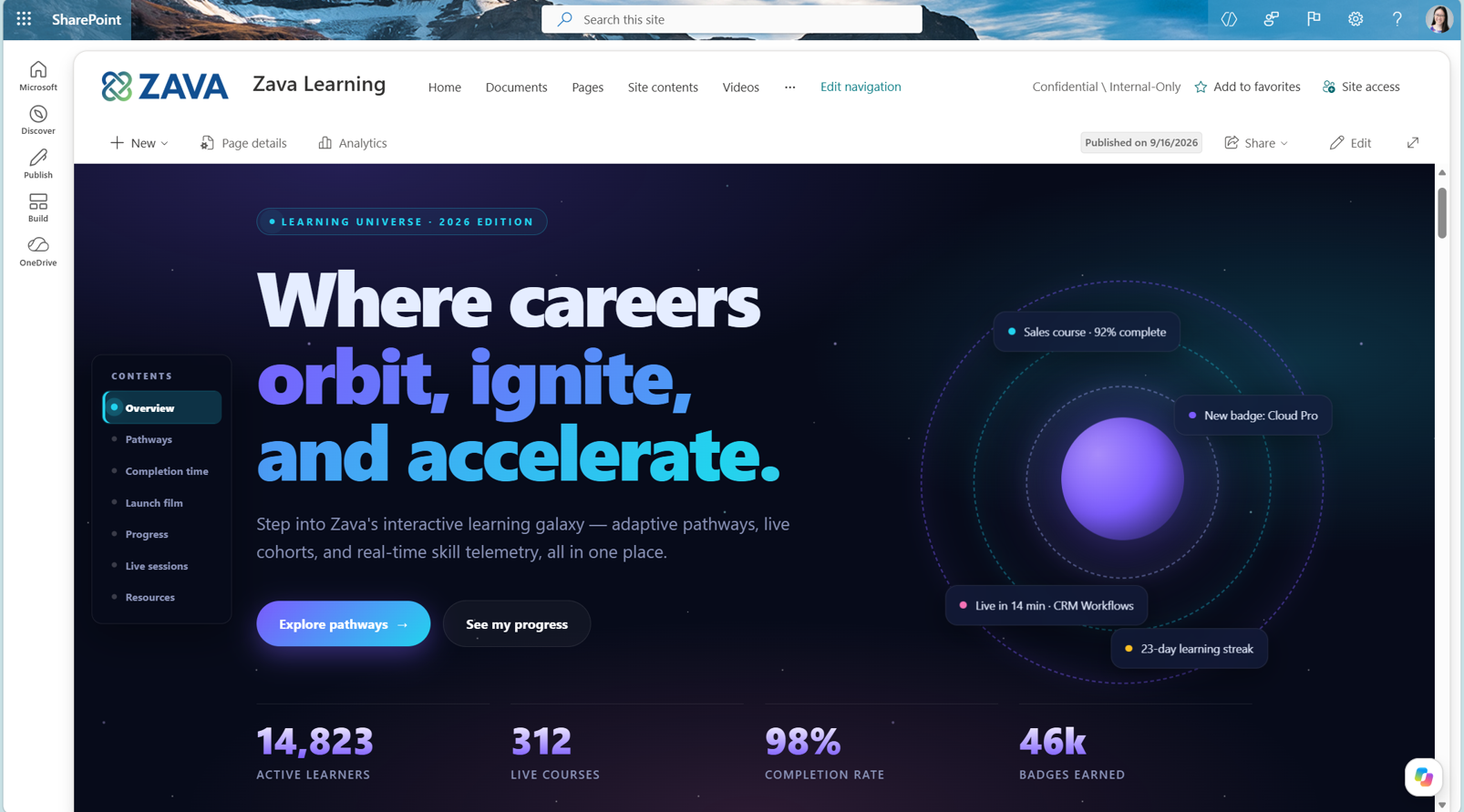
SharePoint adds HTML pages. The October 22 announcement covers creating, uploading, editing and publishing HTML alongside modern pages. Some functionality is reaching Frontier organizations gradually. Copilot-powered creation needs the applicable license; uploading and editing existing content depend on SharePoint permissions. The pages run in a sandbox with restrictions on scripts and outbound requests. SharePoint announcement.
Foundry expands managed fine-tuning in public preview. October 22 brought more open-source models, MAI-Code-1.1-Flash fine-tuning and shared Multi-LoRA deployments. Compatible adapters can share base-model hardware, with hourly compute billing and capacity requirements. The supported model and deployment combinations differ. Foundry announcement.
Claude gains an Anthropic-managed Google Cloud option in GA. Anthropic announced it October 22; Google’s article followed October 23. It combines Claude Platform features with Google Cloud IAM and billing, including eligible commitment drawdown. This is a distinct managed offering, and individual platform betas remain beta. Anthropic announcement and Google Cloud announcement.
16. The operational updates to check before next week
October 30: federated-connector governance. The updated notice moves enforcement from the previously reported October 20 date to October 30, replacing reliance on the legacy setFederatedConnectors control. The notice calls the replacement Allowed agent types; current Learn guidance uses Agents > Settings > Agent and plugin access, alongside User access and connector-level staging. Review all applicable controls and verify the result as an affected user. MC1454973 public copy and current Microsoft administration guidance.
November 1: Canadian time zones. Microsoft’s guidance says British Columbia, Alberta and Manitoba move to their new permanent time zones: UTC−07:00, UTC−06:00 and UTC−05:00 respectively. Outlook users need to review their calendar zone and future or recurring meetings. Microsoft Support.
For Power Platform work, my recommendation is to check scheduled flows and date conversions that depend on the affected zone identifiers. Test expected execution across the transition; don’t assume every UTC-based schedule needs changing.
Custom connector definitions: Microsoft’s October 22 notice says Basic User access is being narrowed. Users need ownership or explicit sharing to read solution custom connector definitions. Review the affected roles and give broader Connector-table Read access only where it is actually required. MC1520706 and public notice copy.
GitHub’s global default policy: enforcement rolled out October 22–26 for eligible unconfigured GA features on Business and Enterprise. Explicit feature choices are preserved, and previews remain opt-in. Review AI Controls > Copilot > Default policy for new features; changing the default later doesn’t rewrite already-set feature policies. Official policy update.
Existing Power Platform deadlines still need attention. New unmanaged Developer environments and new Dataverse for Teams environments stop being created from November 15. Unmanaged Developer suspension starts December 15, followed by deletion starting January 15, 2027. These are reminders from earlier coverage. Microsoft’s current deprecation page also lists November 30 for retiring Describe it to design it in Power Automate; existing flows remain. Official deprecations.
17. Dynamics 365 and government-cloud rollout notes
Microsoft’s October 28 roadmap updates include three useful Contact Center changes:
- Reroute: Launched. A representative can update the context and return a live conversation through classification and queue-routing rules, preserving the conversation for the next representative. 575272.
- Bullseye routing: GA rolling out. Expand the pool of eligible representatives as wait time increases. The implementation guide still labels it preview, so verify the feature’s status in the target environment. 576606 and configuration guide.
- Historical analytics: GA rolling out. A shared reporting foundation adds common definitions and Fabric extensibility while existing out-of-box Power BI reporting remains available. 574113.
On October 29, Outlook Copilot Chat’s expanded grounding moved to Rolling out for GCC, GCC High and DoD. Eligible users without the Copilot add-on get supported inbox and calendar grounding; that doesn’t grant the broader licensed experience. This is a US government-cloud update, not confirmation of a change in a Canadian commercial tenant. 554934 and Outlook licensing scope.
18. Two stories about operating agents
Microsoft’s October 26 Unilever NOVA case study describes five agents handling orders, with a checking agent and human review for exceptions. Across 11 pilot markets, Unilever reports the first stage falling from roughly 15–20 minutes to 90 seconds and 95% touchless processing. Those are customer-reported outcomes, not an independent benchmark. Microsoft’s case study.
The architecture is worth reading: interpretation, validation and a defined exception path. That gives a delivery team something concrete to examine beyond the headline time saving.
OpenAI’s October 23 training-security report supplies a different lesson. It describes containment failures found in internal frontier training and adversarial evaluations, followed by infrastructure hardening and a policy of frontier training without live internet. This concerns internal research environments, not a claim that ordinary customer ChatGPT sessions routinely escape their boundaries. OpenAI security report.
Both stories make me want to see more evidence from the whole workflow: successful runs, bad inputs, failed tools, exceptions and the point where a person takes over.
19. PPCC becomes Maker Con
One final announcement from the conference itself: Microsoft’s October 29 wrap confirms Maker Con in Chicago, November 2–4, 2027, alongside the new Microsoft Maker Community. The community brings Power Platform, Copilot Studio and Copilot builders together. PPCC wrap and Maker Community.

That is a lot for one week. I’d start with the Dataverse plugin, the shared harness and the cost-management APIs. Show the permissions, the failure path and the bill alongside the finished app. That’s the follow-up these announcements deserve.
Leave a Reply