Week of September 21–25, 2026 · Updated Friday, September 25
Microsoft’s Friday announcement takes the lead this week. The new Copilot brings Home, Code and Autopilot together. For Power Platform builders, Work IQ’s business-data preview and Copilot Managed Runtime deserve just as much attention.
Here’s what changed this week, plus the earlier notices with rollout dates and deadlines worth keeping on your list.
This week in 60 seconds
- Copilot’s new app: Home(Chat+Cowork) and Code are heading into Frontier. Autopilots remains a private preview.
- Business context: Work IQ’s Dynamics 365 and Power Platform preview starts September 30. Fabric IQ is generally available in Chat and Cowork.
- Apps and spending: Managed Runtime enters public preview, with new controls for AI costs and model access.
- Models: GPT-6 Sol, Luna and Claude Opus 5.5 arrived Tuesday. The prices and availability details are below.
- Admin dates: Review advanced-package upload permissions before October 25 and GitHub’s new default feature policy before October 22.
In this post
- Copilot Home, Code and Autopilot
- Work IQ, Fabric IQ and app hosting
- AI spending and admin dates
- New models, API prices and caching
- Cowork browser controls
- Dataverse API retirement
- Copilot Studio cost views
- Power BI in Notebooks
- Foundry, WebMCP and reusable context
- My take on the week
Copilot’s Super App gets Home, Code and Autopilot
September 25 · Announced, with staged previews. Microsoft’s new Copilot app makes the “Super App” idea much more concrete:
- Home brings Chat and Cowork together, with Word, Excel and PowerPoint built into the experience.
- Code builds apps and workflows from natural-language requests using the technology behind GitHub Copilot.
- Autopilot, previously Scout, is a persistent cloud agent with its own identity, memory and workspace.
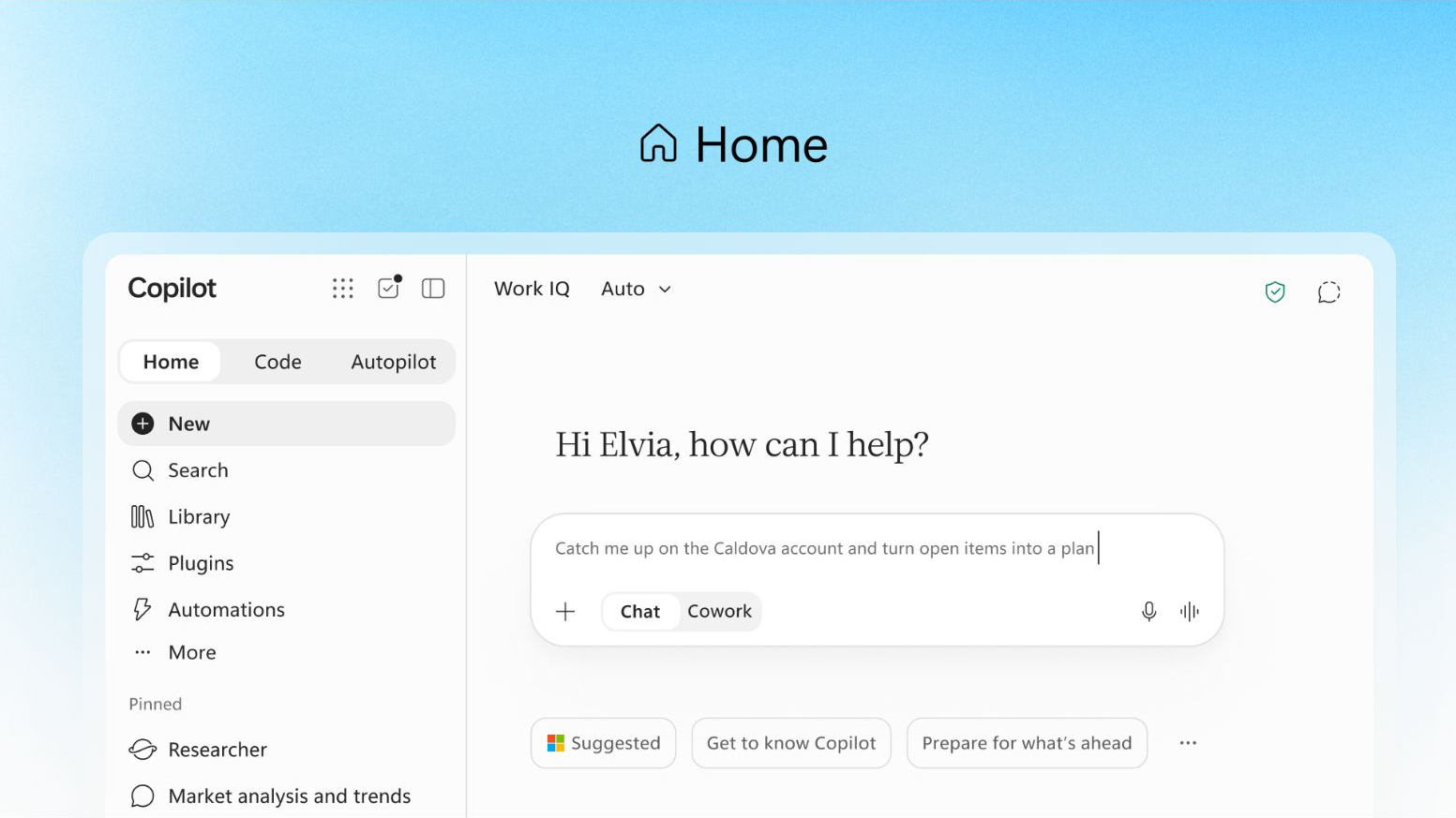
Home and Code start entering Frontier over the coming weeks; the Code section specifies the end of September. Autopilot expands into private preview at month-end.
Also announced: a unified plugin registry rolling out now, Today entering private preview in October, and @Copilot in Teams entering private preview by the end of September.
The part I want to try is moving from a conversation into an editable file or a useful app without rebuilding the context. The announcement sets that expectation; a real customer task will be the test.
Work IQ, Fabric IQ, and a place to run the apps
Work IQ starts using your business definitions
September 25 · Public preview starts September 30. Business applications in Work IQ connects Dynamics 365 and Power Platform data to Copilot and agents. Rollout continues through October; Finance and Operations support is listed for late October.
Its semantic models use selected tables and columns, relationships, views, forms and business terminology to explain what the data means. Makers can refine that context and reuse business skills across connected agents, including Copilot Studio.
Dataverse stores the models and skills. Microsoft also introduces the Dataverse Ask API and business context through the Work IQ MCP server, CLI and coding-agent plugin. Admins still decide which environments and data participate.
This is the preview I want to spend time with. In a custom Dataverse solution, understanding which records belong together is often the hard part. I want to see how much of that understanding carries across agents without maintaining the same explanation in every prompt.
Fabric IQ is available in Chat and Cowork
September 25 · Generally available. The Copilot announcement says Fabric IQ now grounds Chat and Cowork in Fabric and Power BI semantic models. Code integration follows through Frontier. This is separate from the Power BI report references coming to Notebooks below.
Copilot Managed Runtime handles app hosting
September 25 · Public preview. Copilot Managed Runtime provides Microsoft-operated hosting within the Microsoft 365 tenant boundary for apps built in Cowork, Code and Copilot Studio. The SDK and CLI also open that path to professional developers and compatible third-party tools.
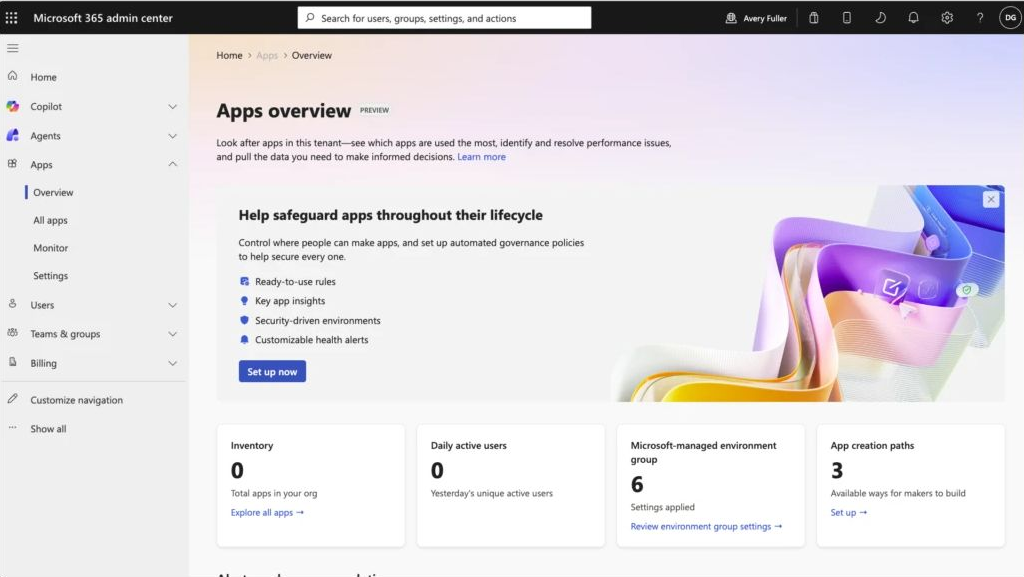
The shared runtime includes Entra identity, governed data connections, Git-backed source and version control, deployment, and an app inventory with usage and health information in the Microsoft 365 admin center.
That gives the app-building story a useful next step: somewhere to host the result, manage access and update it after people start using it.
AI spending controls and admin dates
September 25 · New capabilities and staged rollout. Agent 365 cost management now covers Code and Managed Runtime alongside Cowork and Work IQ APIs. Copilot Studio support is planned for October.
- Model access: controls for which model families a group can use are rolling out for Cowork, including what Auto can select.
- Spending policies: Microsoft Graph API management and credit-request redirects can connect to existing approval workflows.
- User visibility: Cowork users can see consumed and remaining credits and usage history inside Copilot.
- Value reporting: new Cowork consumption views connect spending with the work produced.
Microsoft’s pricing explanation separates the user subscription for everyday work from Copilot Credits for advanced work such as Cowork, Code and Autopilot. A user subscription is required for those capabilities. Enterprise usage-based services remain off until an admin creates a spending policy.
Three dates for the admin list
- September 25 / October 25 — advanced-package uploads: Microsoft’s MC1472007 notice, reproduced in a public archive, updated September 15, schedules the control from September 25. Choose all, no, or selected users/groups before October 25; otherwise advanced uploads remain allowed by default. Basic uploads are unaffected. This is a rollout reminder, not a new announcement today.
- September 25 notice — connected A2A agents: the archived MC1478975 notice describes Agent 365 agents using Agent2Agent as connections in declarative agents. Admins install and approve them; users cannot self-install. The notice’s GA window is late August through late September, so the publication date is not the rollout start.
- October 22 — GitHub’s default feature policy: the September 24 announcement gives Business and Enterprise admins a default for eligible generally available features. Explicit decisions stay intact and previews remain opt-in. Configure it before enforcement starts October 22.
The two Message Center archives reproduce Microsoft’s notices but are independently operated. These dates describe Microsoft’s schedule; I haven’t confirmed the new controls in my tenant.
New models, API prices and caching
September 22 · Rolling out. Microsoft’s announcement brings GPT-6 Sol and Claude Opus 5.5 to Word, Excel, PowerPoint, Chat, Cowork, and Copilot Studio. Availability depends on licence, access, and region, so a rollout announcement doesn’t mean every tenant has both models yet.

Give both models the same account briefing or spreadsheet task, with the same source files, and compare how much correction each result needs.
The new models and their API prices
September 22 · Released. GPT-6 Sol and Luna add lower-cost options to the GPT-6 family. Sol is the one I’d try on everyday coding and document work; Luna’s price makes it interesting for repeated extraction or classification tasks.
| Model | Input | Cache read | Output |
|---|---|---|---|
| GPT-6 Sol | $2.00 | $0.20 | $10.00 |
| GPT-6 Luna | $0.10 | $0.01 | $0.50 |
| Claude Opus 5.5 | $4.00 | $0.20 | $20.00 |
Prices are USD per million tokens. OpenAI’s figures are Standard pricing for prompts with up to 272K input tokens; Anthropic’s are its standard Opus 5.5 rates. Cache writes, longer prompts, other processing tiers, and tool charges need to be checked separately. Sources: OpenAI’s September 22 API changelog and Anthropic’s launch pricing.
OpenAI also launched both models in ChatGPT Work and Codex for Plus, Pro, Business, Enterprise, and Edu. Its launch notice says Free and Go users get Luna in the desktop app, and that the models were not yet available in Chat.
Claude Opus 5.5 is also in Microsoft Foundry
Microsoft lists Opus 5.5 as generally available in Foundry, hosted on Azure, with Global Standard and US Data Zone deployment offers. The published input and output rates match the $4 and $20 figures above.
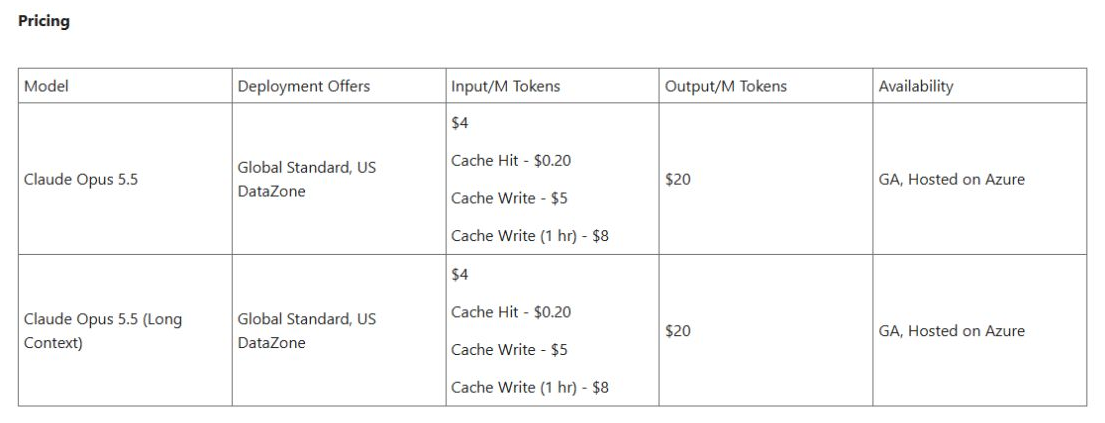
Anthropic reports that Opus 5.5 costs about 40% less than Opus 5 on its typical test workloads at default settings. The input and output token prices fell 20%; the larger workload saving also depends on efficiency. I wouldn’t put a flat 40% saving into a project estimate.
GPT-6 caching and repeated input costs
September 22 · API update. OpenAI’s prompt-caching post explains improvements to how GPT-6 reuses repeated context. Eligible shared prompt prefixes reused within 30 minutes can receive cache discounts, with savings of up to 90% on cached input tokens.
That percentage applies to cached input, not the whole bill. Output tokens and other charges still count.
The post also covers a caching dashboard, diagnostics for missed cache reuse, and explicit breakpoints for choosing which part of a prompt to cache. It describes ways to change reasoning effort and tool availability while keeping earlier context reusable.
For an agent that carries the same instructions and tool definitions through dozens of calls, I’d look at cache hit rates before cutting useful context just to save tokens.
Cowork browser controls
Microsoft’s MC1474461, published September 19, schedules controls for specific users or groups in mid-to-late September. Browser use is off by default.
Cowork uses a hidden tab in your local Edge browser and your existing signed-in session. Cookies, credentials and session tokens stay on the device. Microsoft documents browser automation for Cowork on the web in Edge; desktop and mobile do not support this capability.
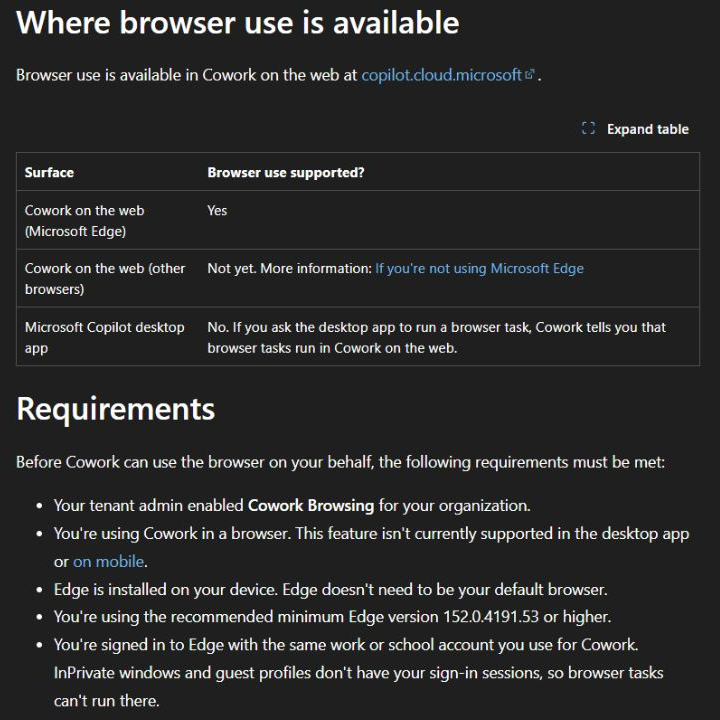
The browser documentation explains handbacks for sign-in, MFA and CAPTCHA. Admin guidance covers Conditional Access, DLP, auditing and usage-based consumption.
Start with a small group and an approved test system. Exercise the approval step, interrupt a run, then inspect the audit and consumption records. Browser permission and general Cowork access through spending policies are separate controls; a pilot needs both.
Check your old Dataverse discovery calls
MC1474128 sets September 21, 2026 as the end-of-support date for the legacy Global Discovery Service REST API and says the affected endpoints will no longer be available.
Search custom environment selectors, admin utilities and older integration or ALM scripts for globaldisco.crm.dynamics.com.
For Git-tracked files, run git grep -n -F 'globaldisco.crm.dynamics.com'. Also review deployed configuration and scripts stored outside the repository.
Microsoft points custom integrations to the Power Platform List Environments API, with token scope:
https://api.powerplatform.com/.default
Check Entra permissions, authentication and response mapping, then test the migration.
The notice excludes Dataverse Developer Tools such as the CRM SDK and connectors. Focus on custom REST calls to the affected endpoints.
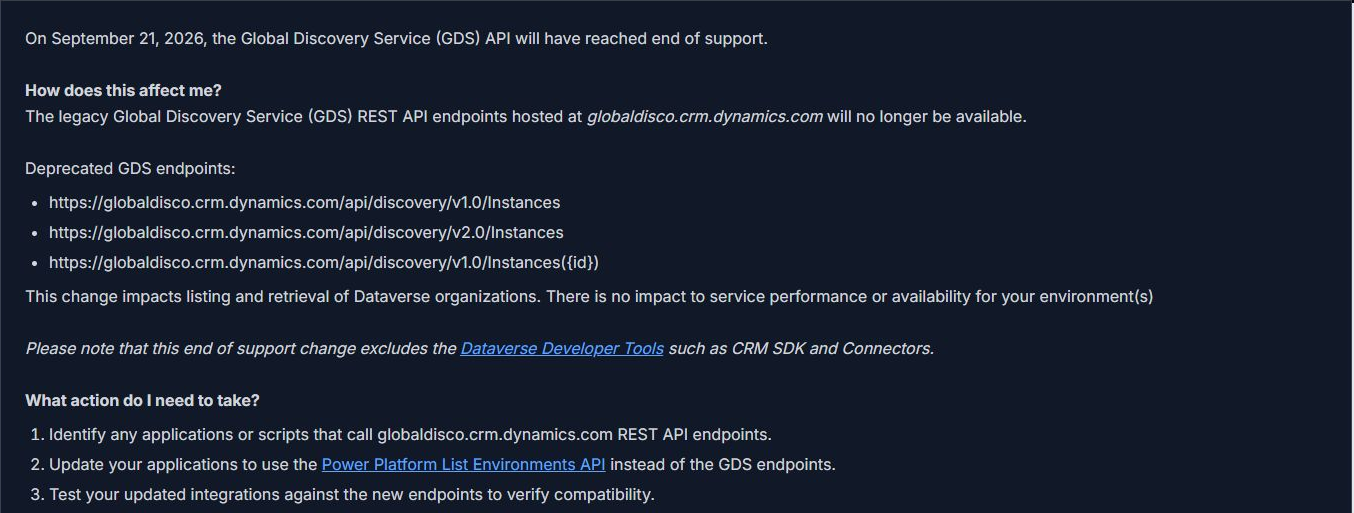
The independent archive reproduces the dated notice. Microsoft’s older discovery documentation still shows the retired endpoints; I haven’t tested whether they remain reachable.
Copilot Studio costs need to be visible while we build
Agents using the GitHub Copilot harness can consume credits during building, testing, evaluations, and runtime, according to Microsoft’s current guidance. A Microsoft 365 Copilot licence doesn’t cover that usage.
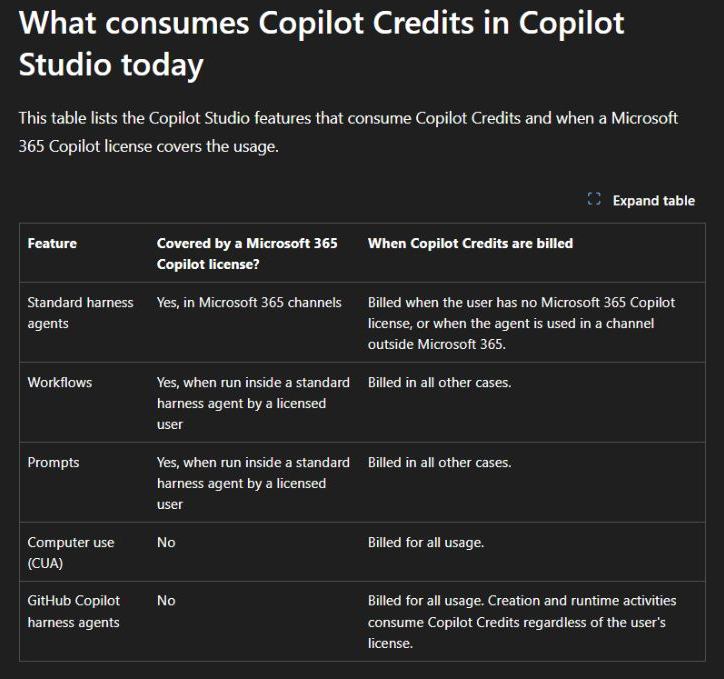
The useful distinction is how much went on production, testing or evaluations.
These roadmap items were added earlier in September and remain on my watchlist. Microsoft plans to show costs in three places:
| Roadmap item | What it is intended to show |
|---|---|
| 571194: Preview Chat and History | Consumption associated with preview/testing and historical runs. |
| 571195: Agent Evaluations | Costs for evaluation generation, test execution, and model grading. |
| 571196: Monitor | Per-agent costs and an estimated split across authoring, testing, evaluations, and production. |
The archived entries are marked In development, with a September 2026 target. I couldn’t confirm the individual records on the live roadmap, so I’m treating them as planned features.
You can check the Microsoft roadmap using those IDs. Archived copies of Microsoft’s text are linked in the sources below.
Until the cost views arrive
Keep track of what you change between test runs. When the cost views become available, that record should help explain why one run cost more than another.
Microsoft already documents monthly agent limits with Stop usage and environment capacity settings. Disabling access to unallocated prepaid capacity won’t stop consumption through a linked pay-as-you-go plan.
I covered the Cowork reporting side in my first-month admin guide. For Copilot Studio, I’d include development and testing when working out what an agent costs.
Power BI reports are coming to Copilot Notebooks
The September 19 notice MC1474458 says users will be able to add Power BI reports as references alongside files for summaries, presentations and briefs.
- Public preview: late September through mid-October 2026.
- General availability: late October through mid-November 2026.
The notice says no extra setup is needed beyond users already having Power BI and Copilot. These are planned windows, separate from Friday’s Fabric IQ availability in Chat and Cowork.
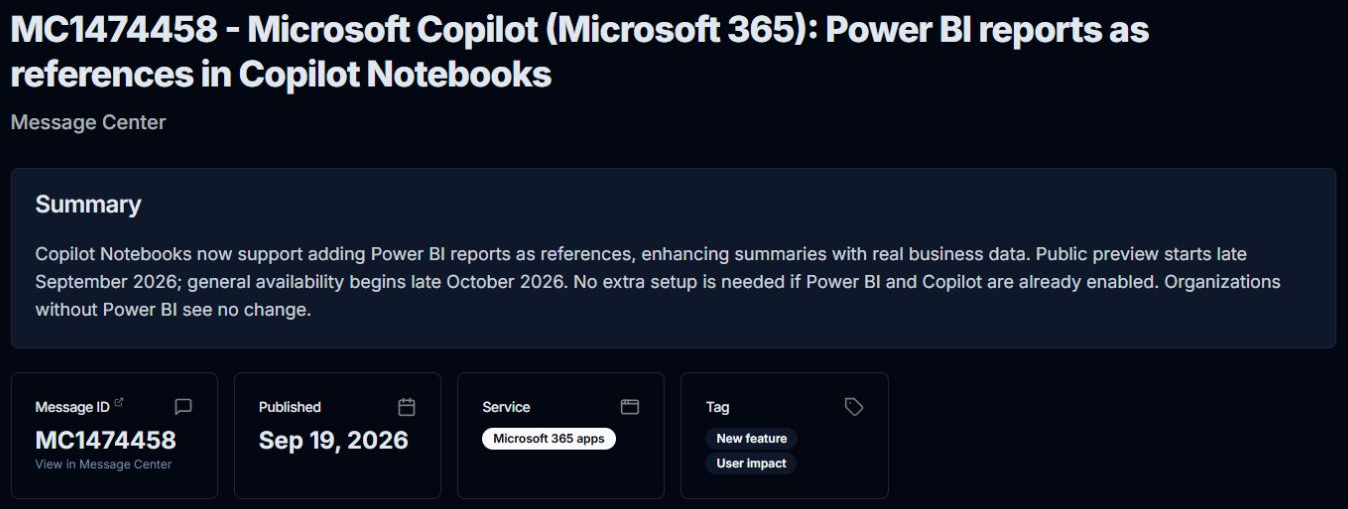
For an account review, try a sales report, account plan and meeting notes in one Notebook. Ask for performance changes, outstanding commitments and source citations. Compare the output with the report and repeat with users who have different permissions. Adding a reference should not be treated as unrestricted access to its underlying datasets.
More for builders: Foundry, WebMCP and reusable context
DeepSeek-V4.1-Flash: check the deployment path
September 23. Microsoft’s Foundry announcement describes DeepSeek-V4.1-Flash with text and image input, up to one million tokens of context, and adjustable reasoning effort. The availability labels differ: Direct from Azure is in public preview; Fireworks on Foundry is generally available.
The same post announces a Global deployment option for GLM-5.3-Flash through Fireworks and adds Global deployment for Kimi K3 alongside its existing Data Zone option. Those choices can affect where and how a model is deployed, so I’d check the model card before comparing prices.
Edge’s WebMCP implementation is ready for testing
September 21 · Early testing. Microsoft’s Edge developer update says developers can try its WebMCP implementation. It lets a website expose structured tools that a browsing agent can call using the site’s existing front-end code. Microsoft has samples and an extension for testing and debugging those tools.
This caught my attention for business portals. A site could describe an action explicitly instead of relying on the agent to work out every step from the page. It’s something to experiment with; the announcement isn’t a claim of built-in Power Pages support.
Microsoft’s governance guidance looks beyond the agent inventory
September 22 · Guidance. In a Copilot Studio post ahead of October’s Power Platform Conference, Microsoft argues for monitoring changes in agent ownership, access, usage, cost, and behaviour, then responding according to risk. It discusses Agent 365 and automating decisions that already have a defined policy.
How V7 gives agents reusable context
OpenAI’s September 21 V7 case study looks at a problem that comes up in agent design: how to reuse information from company files across tasks.
V7 uses GPT-5.6 Luna to extract information from files into a Context Graph connecting entities, relationships, and cited evidence. Agents can query that context through MCP, with stronger models used for harder reasoning.
V7 reports Astra reaching 89% accuracy versus Sol’s 78% on its hardest graph-query tests. Those are customer-reported results in an OpenAI case study, not a general accuracy guarantee.

For a Dataverse project, I’d take that as a design prompt: how should an agent connect a record to its supporting documents and show the evidence behind an answer?
My take on the week
The new Copilot app is the headline. Work IQ is where I want to dig deeper: a custom Dataverse solution has business meaning in its relationships, forms and views, and I want to see how well agents can reuse it.
Managed Runtime also makes the app story more interesting. Once someone builds a useful tool, hosting, access and updates become ongoing work. Having those pieces connected to Microsoft 365 could make a real difference.
The model releases still deserve testing, and the Dataverse retirement still needs attention. But Friday changed the focus of this edition. Next week, I’m watching what actually arrives in Frontier and the September 30 Work IQ preview.
Sources
- New Copilot and Fabric IQ: Microsoft, September 25.
- Business applications in Work IQ: Microsoft Dynamics 365 Blog, September 25.
- Managed Runtime: Microsoft Copilot Blog, September 25.
- AI spending: FinOps capabilities and Copilot pricing model, September 25.
- GitHub feature defaults: GitHub Changelog, September 24.
- Admin notices: MC1472007 reproduction and MC1478975 reproduction (independent archives).
- Copilot model rollout: Microsoft, September 22.
- GPT-6 Sol and Luna: OpenAI’s launch announcement and API changelog.
- Claude Opus 5.5: Anthropic’s launch announcement and Microsoft Foundry availability.
- Prompt caching: OpenAI, September 22.
- Foundry model options: Microsoft, September 23.
- WebMCP: Microsoft Edge developer update, September 21.
- Agent governance: Microsoft Copilot Studio Blog, September 22.
Message Center links require an authorized Microsoft 365 admin account. Public archives below reproduce the original notices or roadmap entries but are not Microsoft-operated sites.
- Cowork browser controls: MC1474461, local browser documentation, and Cowork admin guidance.
- Dataverse discovery retirement: MC1474128, public copy of the notice, and the existing discovery-service documentation.
- Copilot Studio costs: current cost-management guidance, Microsoft roadmap, and archived Microsoft entries 571194, 571195, and 571196.
- Power BI in Notebooks: MC1474458 and public copy of the full notice.
- V7: OpenAI’s September 21 customer case study.


Leave a comment